
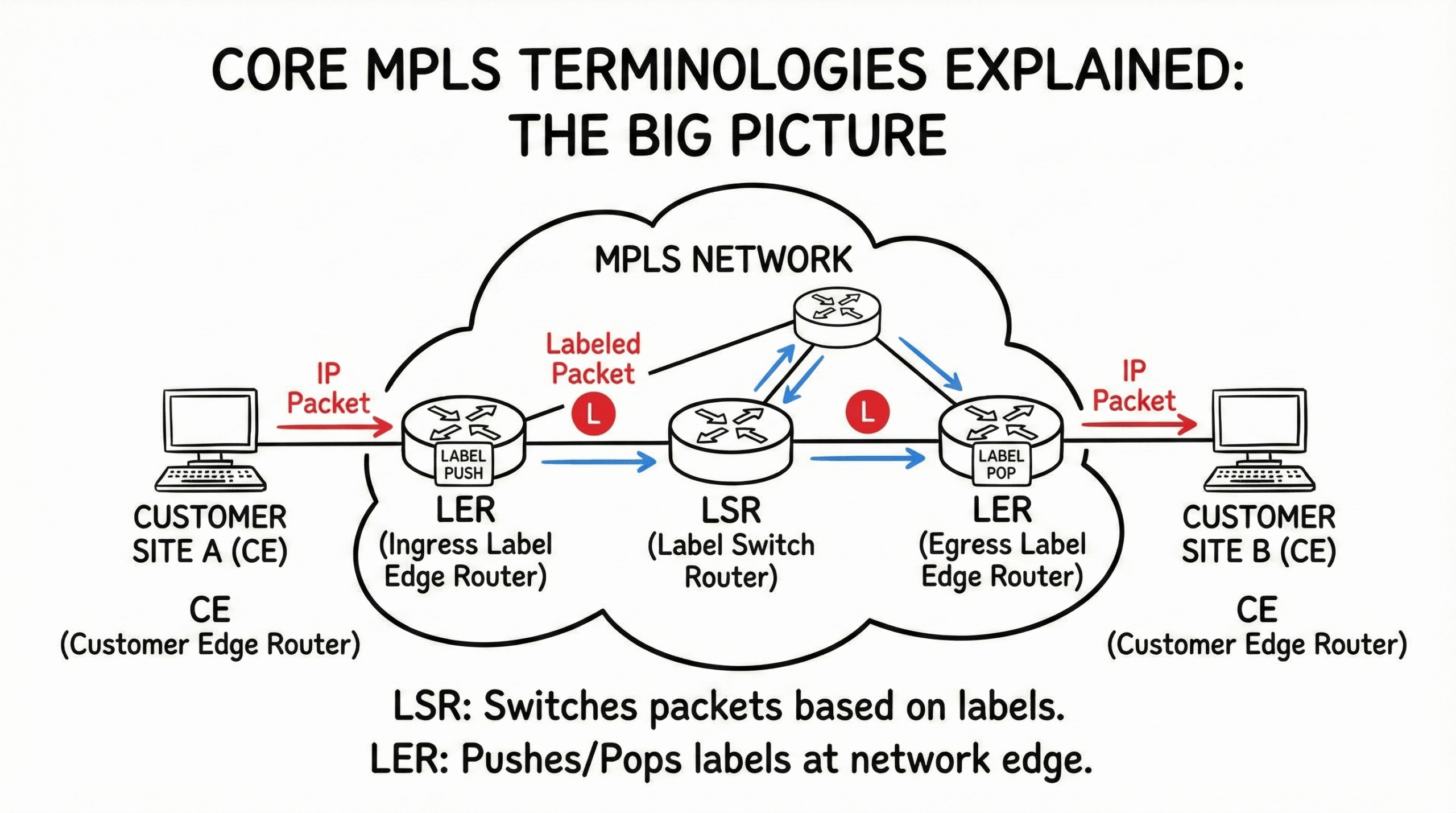
As a senior network engineer, I’ve witnessed firsthand the dramatic evolution of network technologies. While innovations like SD-WAN and cloud networking are now standard, fundamental concepts like MPLS remain vital, especially in service provider and large enterprise networks. Understanding MPLS is crucial for navigating these complex infrastructures, particularly as it continues to advance with modern enhancements like Segment Routing.
This post aims to update and clarify the essential MPLS terminologies, reflecting current deployments and best practices. While the core definitions haven’t changed, their context within today’s automation-driven, cloud-integrated networks certainly has.
Core MPLS Terminologies Explained
Let’s dive into the fundamental terms that define Multiprotocol Label Switching (MPLS).
MPLS (Multiprotocol Label Switching)
MPLS originated from proprietary solutions, notably Cisco’s Tag Switching, but was standardized by the IETF to create an open and interoperable forwarding mechanism. Fundamentally, MPLS is a technique where network packets are forwarded based on short path identifiers called labels, rather than solely relying on destination IP address lookups in a routing table. This design enables high-performance forwarding, sophisticated traffic engineering capabilities, and the creation of virtual private networks (VPNs) over shared infrastructure.
While often simplified as “no more routing lookups,” in modern MPLS deployments, label lookups are seamlessly integrated with IP routing information for dynamic policy application, fast reroute, and resilient path selection. This combination ensures robust and adaptable network behavior, especially when augmented by Segment Routing.
LER (Label Edge Router)
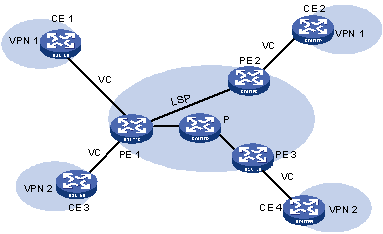
The Label Edge Router (LER) is a critical device positioned at the boundary of an MPLS domain. Its primary function is to “impose” labels on incoming IP packets as they enter the MPLS cloud, acting as an Ingress LER. Conversely, it “disposes” or removes labels from packets as they exit the MPLS cloud, operating as an Egress LER. LERs are commonly known as PE (Provider Edge) routers. In contemporary network architectures, PEs frequently serve as gateways for advanced overlay services like EVPN/VXLAN, extending label-switched capabilities into data centers or other network segments.
LSR (Label Switch Router)
A Label Switch Router (LSR) operates within the core of an MPLS network. Its primary role is to forward packets based on their labels. When a labeled packet arrives, the LSR performs a label swap, replacing the incoming label with a new outgoing label, and then forwards the packet to the next hop along the Label Switch Path (LSP). LSRs are typically referred to as P (Provider) routers. In cloud-native and Software-Defined Networking (SDN) environments, LSR functions can be virtualized and performed by software-defined network elements or containerized routers.
CE (Customer Edge Router)
The Customer Edge (CE) router is located at the client’s premises and connects directly to the ISP’s MPLS network (specifically, to a PE router). The CE router typically remains unaware of the underlying MPLS technology; it simply forwards IP packets to the PE, relying on the ISP’s MPLS cloud for efficient transport.
Label
An MPLS label is a 32-bit (4-byte) identifier, similar in structure to a traditional IP packet header, used to make forwarding decisions. These labels can be stacked, enabling hierarchical routing and complex service delivery. With the advent of Segment Routing (SR-MPLS), label stacks can represent an ordered list of network segments, facilitating more granular traffic engineering and explicit path control.
Label Binding
Label binding refers to the process of associating a specific label with a Forwarding Equivalence Class (FEC). This mapping allows a router to know which label to assign to a group of packets that require the same forwarding treatment.
FEC (Forwarding Equivalence Class)
A Forwarding Equivalence Class (FEC) is a classification of IP packets that are forwarded in an identical manner, along the same path, and with the same forwarding treatment within the MPLS domain. For example, all packets destined for a particular IP prefix might belong to the same FEC.
LSP (Label Switch Path)
A Label Switch Path (LSP) is a predefined, unidirectional path that labeled packets follow through an MPLS network, from an Ingress LER to an Egress LER. It is constructed by a series of LSRs that forward labeled packets based on their associated FEC.
PHP (Penultimate-Hop-Popping)
Penultimate-Hop-Popping (PHP) is an optimization mechanism in MPLS where the top label of the label stack is removed (popped) by the penultimate (second-to-last) LSR in an LSP, one hop before the Egress PE router. This reduces the processing load on the Egress PE, as it receives a plain IP packet, which it can then route normally.
MPLS Control and Data Plane Components
To fully grasp how MPLS operates, it’s essential to distinguish between the control plane and the data plane, and the key tables they utilize for their respective functions.
RIB (Routing Information Base)
The Routing Information Base (RIB) is the central repository of all routing intelligence within a router’s control plane. It’s a comprehensive database containing all potential routes learned from various routing protocols (e.g., OSPF, IS-IS, BGP). The RIB stores the best paths to all known destinations. You can typically inspect the RIB using vendor-specific commands. For Cisco devices, a common command is:
Router# show ip route
LIB (Label Information Base)
The Label Information Base (LIB) is the MPLS equivalent of the RIB within the control plane. It’s a table that stores all locally generated and learned label bindings for various FECs. The LIB contains the mappings between network prefixes and the labels assigned to them. To inspect the LIB, you’ll use vendor-specific commands. For Cisco, a widely used command is:
Router# show mpls ldp bindings
For other vendors like Juniper or Arista, please refer to their latest documentation for equivalent commands such as show ldp bindings or show mpls ldp binding.
FIB (Forwarding Information Base)
The Forwarding Information Base (FIB) is the data plane table derived from the RIB. It contains the optimized, best paths for IP packet forwarding. On Cisco devices, the FIB is a core component of Cisco Express Forwarding (CEF), designed for extremely fast lookup and forwarding. The FIB is consulted when an unlabeled IP packet needs to be routed. You can often view the FIB content using the same command as the RIB, as it directly reflects the active routes:
Router# show ip route
LFIB (Label Forwarding Information Base)
The Label Forwarding Information Base (LFIB) is the data plane table specifically for labeled packets, derived from the LIB. It stores the active labels and their corresponding next-hop information used for forwarding MPLS packets. When an MPLS packet arrives, the LFIB is consulted for the label swap and the next-hop decision. On Cisco platforms, you can check the LFIB with:
Router# show mpls forwarding-table
As with other commands, always consult vendor documentation for platform-specific equivalents (e.g., show mpls table on Juniper).
Control Plane
The Control Plane is responsible for building and maintaining the network’s intelligence and state. It utilizes routing protocols (like OSPF, IS-IS, BGP) to populate the RIB, and label distribution protocols (like LDP or RSVP-TE) to populate the LIB. Its primary role involves computing optimal paths, distributing labels, and ultimately constructing the FIB and LFIB tables for the data plane.
Data / Forwarding Plane
The Data Plane (or Forwarding Plane) is where the actual high-speed packet forwarding occurs. It consults the FIB for unlabeled IP packets and the LFIB for labeled packets. The data plane is responsible for the rapid operations of pushing, popping, and swapping labels as packets traverse the MPLS network.
Label Distribution Protocols
Labels must be distributed and synchronized across all LSRs within an MPLS domain. This critical function is handled by specific protocols.
LDP (Label Distribution Protocol)
LDP is the standard (RFC 5036) protocol predominantly used for distributing labels in an MPLS network. LDP peers establish sessions and exchange label bindings, typically for IPv4 and IPv6 prefixes (LDPv6). It forms the backbone of many traditional MPLS VPN services and is widely deployed across various vendor platforms.
RSVP-TE (Resource Reservation Protocol – Traffic Engineering)
While not primarily a “label distribution” protocol in the same vein as LDP, RSVP-TE is crucial for establishing LSPs that can support explicit traffic engineering constraints (e.g., specific bandwidth requirements, latency guarantees). It signals explicit paths and reserves resources along them, providing granular control over traffic flow in MPLS networks for scenarios demanding strict QoS.
Segment Routing (SR-MPLS / SRv6)
Segment Routing (SR), standardized in RFC 8402, represents a significant modernization and simplification of MPLS and enhances traffic engineering capabilities. Instead of relying on traditional signaling protocols like LDP or RSVP-TE to build LSPs hop-by-hop, SR encodes the entire path information directly into the packet header as a stack of “segments” or labels. SR-MPLS leverages the existing MPLS forwarding plane, while SRv6 extends this concept to IPv6, carrying segment lists within IPv6 routing headers. Segment Routing is a transformative technology for network automation, offering powerful traffic engineering and network slicing capabilities via a controller-less or controller-driven approach.
MPLS in the Modern Network Landscape
While the core MPLS terminologies remain foundational, the way MPLS is deployed, managed, and integrated into broader network architectures has significantly evolved in recent years:
- SD-WAN Integration: In many enterprise WANs, MPLS is now often just one of several transport options (alongside broadband, LTE/5G), all orchestrated by a Software-Defined Wide Area Network (SD-WAN) solution. MPLS provides a secure, high-performance underlay, while SD-WAN overlays deliver application-aware routing, centralized management, and hybrid connectivity.
- Cloud Networking: MPLS extends seamlessly into cloud environments through private interconnections (e.g., AWS Direct Connect, Azure ExpressRoute), offering dedicated, high-bandwidth, and low-latency paths to cloud providers.
- Network Automation: Modern MPLS deployments heavily leverage automation frameworks. Tasks like configuration management, service provisioning, and operational troubleshooting are increasingly performed using declarative automation tools (e.g., Ansible, Nornir, Scrapli), model-driven APIs (NETCONF, RESTCONF, gNMI), and infrastructure-as-code principles.
- Enhanced Observability: Real-time, model-driven telemetry (via gRPC, gNMI, streaming sFlow/IPFIX) provides unprecedented visibility into MPLS networks. Tools like Suzieq enable advanced analytics and AI-enhanced monitoring, ensuring service quality, proactive issue detection, and compliance with SLAs.
- Zero Trust Architectures: While MPLS efficiently provides network transport, security is increasingly enforced at the edges and within the network using granular segmentation, micro-segmentation, and policy-driven access controls, aligning with modern Zero Trust principles.
Understanding these foundational MPLS concepts, especially in the context of Segment Routing and modern operational practices, will equip you to work effectively with both traditional and next-generation networks. I’ll be diving deeper into practical scenarios, including automation workflows for MPLS and Segment Routing, in upcoming posts. Stay tuned!

- Best Routers for AT&T Fiber Internet (Tested for IP Passthrough) - March 26, 2026
- Best PoE Switches for Home Lab and Small Business (2026) - March 25, 2026
- Best Routers for T-Mobile Home Internet in 2026 (Tested Behind the Gateway) - March 19, 2026