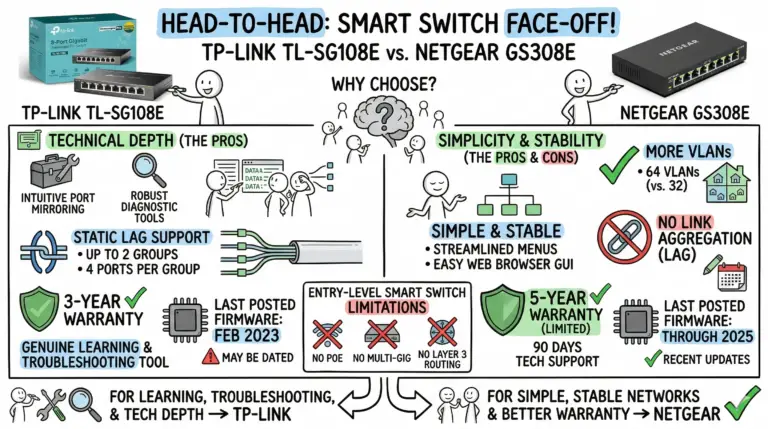
If you are building a home lab or small business network, a PoE switch is the piece of gear that quietly eliminates the most cable clutter. Instead of running a data cable and a power cable to every access point, camera, and VoIP phone, you run one Ethernet cable and the switch handles both. One port. One cable. Device powered and connected.
You do NOT need a PoE switch if:
- Every device on your network already has its own power adapter and you have no APs, cameras, or VoIP phones planned
- Your total PoE device count is one or two — a single PoE injector is cheaper than a full switch
- You are not segmenting traffic with VLANs and have no plans to do so — a plain unmanaged switch saves money
- Your budget is under $40 — at that price, an unmanaged non-PoE switch is the right starting point
Key Takeaways
- TP-Link TL-SG108PE V3 is the best overall budget pick — 4 PoE+ ports, 64W, VLAN/QoS, fanless, under $60. The one to start with.
- NETGEAR GS308EP is the right pick when every port needs to be PoE+ — all 8 ports powered, smart managed, completely silent.
- NETGEAR GS308PP is the camera specialist — 83W unmanaged, plug-and-play, handles 12 cameras without breaking a sweat.
- TP-Link TL-SG2210MP is the serious lab switch — 150W PoE budget, full Omada SDN, IOS-style CLI, 2x SFP uplinks. Crosses into real enterprise territory.
- Ubiquiti USW-Lite-8-PoE is the obvious choice if you are already running UniFi — adopts in 60 seconds, fully managed Layer 2, completely fanless.
- TP-Link TL-SG1218MP is the 16-port powerhouse — 250W PoE budget, rack-mountable, unmanaged plug-and-play. Maximum headroom for growing labs.
What to Look for in a PoE Switch
1. Total PoE budget, not per-port wattage. The number that matters is the total watts the switch can deliver simultaneously across all ports. A switch with 8 PoE+ ports at 30W each does not give you 240W — it gives you whatever the total budget is (62W, 83W, 150W). Add up your device loads and add 20% headroom before buying.
2. Managed vs unmanaged. If you need VLANs to segment IoT, cameras, and servers, you need a managed or smart-managed switch. If you just need power and data delivered to cameras with no segmentation, unmanaged is simpler and cheaper. Learn the full difference in our managed vs unmanaged switch guide.
3. Fanless vs fan-cooled. For a home office or quiet rack, fanless is non-negotiable. Switches with fans under heavy PoE load are audible in a quiet room. Every sub-$100 option on this list is fanless. The two higher-wattage switches (TL-SG2210MP and TL-SG1218MP) have fans — mount them in a closet or cabinet.
4. Ecosystem fit. If you run UniFi, buy UniFi. If you run TP-Link Omada, the TL-SG2210MP integrates cleanly. If you run pfSense or OPNsense standalone, any of the TP-Link or NETGEAR options work — they all use standard 802.1Q tagging. See the home lab gear guide for the complete stack.
Best PoE Switches — Top 6 Picks
| TP-Link TL-SG108PE V3 — 8-Port Gigabit PoE+ Smart Switch |  | Best Overall Budget | PoE: 4x PoE+ ports, 64W total budget | Management: Smart managed — VLAN, QoS, IGMP | Note: Fanless, metal chassis, PoE Auto Recovery | VIEW LATEST PRICE | Read Our Analysis |
| NETGEAR GS308EP — 8-Port All-PoE+ Smart Managed Switch |  | Best All-Port PoE Managed | PoE: 8x PoE+ ports, 62W total budget | Management: Smart Managed Essentials — VLAN, QoS | Note: Every port PoE+, fanless, metal build | VIEW LATEST PRICE | Read Our Analysis |
| NETGEAR GS308PP — 8-Port Unmanaged PoE+ Switch 83W |  | Best for IP Cameras | PoE: 8x PoE+ ports, 83W total budget | Management: Unmanaged — plug and play | Note: FlexPoE expandable, handles 12+ cameras | VIEW LATEST PRICE | Read Our Analysis |
| TP-Link TL-SG2210MP — 10-Port Omada Managed PoE Switch |  | Best Omada Managed + SFP | PoE: 8x PoE+ ports, 150W total budget | Management: Full Omada SDN / IOS CLI / Standalone | Note: 2x SFP uplinks, 5-year warranty | VIEW LATEST PRICE | Read Our Analysis |
| Ubiquiti USW-Lite-8-PoE — UniFi 8-Port PoE Switch |  | Best for UniFi Ecosystems | PoE: 4x PoE+ ports, 52W total budget | Management: Full UniFi Controller — Layer 2 | Note: Fanless, wall-mount kit included | VIEW LATEST PRICE | Read Our Analysis |
| TP-Link TL-SG1218MP — 16-Port Gigabit PoE Switch 250W |  | Best 16-Port Growing Lab | PoE: 16x PoE+ ports, 250W total budget | Management: Unmanaged (dip-switch) + 2x SFP combo | Note: 1U rack-mountable, highest wattage on list | VIEW LATEST PRICE | Read Our Analysis |
More Details on Our Top Picks
-
TP-Link TL-SG108PE V3 — Best Overall Budget PoE Switch
Best Overall Budget PoE SwitchView Latest Price✓ Pros- VLAN, QoS, IGMP Snooping — real managed features under $60
- PoE Auto Recovery reboots dead APs without manual intervention
- Completely fanless — silent in any room
- Metal chassis with shielded ports — built to last
- Powers UniFi APs and pfSense VLAN trunks out of the box
✗ Cons- Only 4 PoE ports — not enough if you need to power 5+ devices
- 64W total budget — two modern Wi-Fi 6E APs nearly maxes it
- HTTP management only — no HTTPS on the web interface
If you are just starting your home lab and need a PoE switch that covers the basics without locking you out of VLANs later, the TL-SG108PE V3 is the single best value on this list. It gives you 4 PoE+ ports with a 64W total budget — enough to power two Wi-Fi 6 access points and a couple of IP cameras simultaneously, all at 30W max per port. The other 4 ports are standard Gigabit for your servers, NAS, or desktop. The fanless metal case means it sits in your office rack without a sound.
Here is what separates this from a dumb unmanaged PoE switch: the web interface gives you 802.1Q VLAN tagging, port-based QoS, and IGMP Snooping. For a home lab running pfSense or OPNsense, that VLAN capability is essential. You can segment your IoT cameras onto their own VLAN, keep your lab servers isolated, and trunk 802.1Q tags to your firewall — all for under $60. PoE Auto Recovery is a standout feature: the switch automatically detects when a powered device stops responding and reboots it, no manual cycling needed. See our VLAN setup guide and home lab gear guide for how this switch fits a full lab stack.
💬 What Real Users SayA sysadmin confirmed it powered two APs and a camera out of the box with zero configuration issues and clean integration into pfSense VLANs. Multiple home lab users confirm it works as the edge PoE switch in an Omada-managed network — separate admin, IoT, guest, and camera VLANs all running simultaneously. One owner noted the V3 revision fixed the long-term reliability issues that affected V1 units.
⚠ Who Should Skip ThisIf you need more than 4 PoE devices powered simultaneously, the 64W total budget becomes a hard ceiling fast. A modern Wi-Fi 6E AP can draw 25–30W under load — two APs alone will nearly max the budget with nothing left for cameras. Step up to the TL-SG2210MP for 150W headroom. Also note: the management interface runs HTTP only, not HTTPS — acceptable on a dedicated management VLAN, but worth knowing.
🎯 My TakeThis is the switch I spec into every Tier 2 home lab build as the edge PoE layer. At under $60 it gives you VLAN awareness, PoE Auto Recovery, and a metal fanless chassis that will still be running five years from now. The V3 hardware revision resolved the V1 reliability concerns. If you are building your first managed home lab network and need PoE, start here.
- Ports:8x Gigabit Ethernet (ports 1–4 PoE+, ports 5–8 non-PoE)
- PoE Standard:IEEE 802.3at (PoE+) and 802.3af — up to 30W per port
- Total PoE Budget:64W
- PoE Auto Recovery:Yes — auto-detects and reboots unresponsive PoE devices
- VLANs:802.1Q tagged + port-based + MTU VLAN
- QoS:Port-based, 802.1p, DSCP priority
- IGMP Snooping:Yes
- Management:Web GUI + EasySmartConfigure utility (HTTP)
- Chassis:Metal, fanless, desktop or wall mount
- Warranty:3-year limited
-
NETGEAR GS308EP — Best All-Port PoE+ Smart Managed Switch
Best All-Port PoE Smart Managed SwitchView Latest Price✓ Pros- All 8 ports are PoE+ — never guess which port to use
- Smart managed: VLAN, QoS, IGMP, port mirroring
- Completely fanless and silent
- Solid metal build — heavy and sturdy
- 3-year warranty with next business day support
✗ Cons- 62W total budget — lowest watt-per-port ratio on this list
- External PSU has failed on some units within 90 days
- NETGEAR RMA process is cumbersome — requires purchase proof and phone navigation
The GS308EP flips the script on the TP-Link: instead of 4 PoE ports and 4 regular ports, every single one of the 8 ports is PoE+. That matters when you are wiring a location where every device needs power — eight IP cameras, a mix of VoIP phones and APs, or a fully PoE-powered closet. You never have to think about which port to plug into. The 62W total budget is shared across all 8, so average available power per port under full load is about 7.75W — which is why you should plan your device mix carefully (cameras at 6–8W each, APs at 15–25W each).
NETGEAR’s Smart Managed Essentials software gives you VLAN, QoS, IGMP Snooping, and port mirroring — the same essentials as the TP-Link, from a different interface. The build quality is solid metal. It runs completely fanless and silent. In a home lab, it wall-mounts cleanly without noise or heat concerns. For the managed vs unmanaged switch decision framework and our full network switch roundup, see those dedicated guides.
💬 What Real Users SayA home lab enthusiast runs two of these PoE switches and praises the enterprise-level functionality at a small-switch price point. Users running home surveillance confirm it powers cameras and APs plug-and-play with no configuration needed for basic setups. One reviewer calls it an upgrade from consumer grade — solid construction, enterprise feel. Enterprise IT professionals note it is ideal for deployments where a small PoE-aware managed switch fits perfectly.
⚠ Who Should Skip ThisThe 62W total is lower than the GS308PP (83W) and much lower than the TL-SG2210MP (150W). If you plan to power multiple modern Wi-Fi 6E APs drawing 25–30W each, the budget will run short quickly. The external PSU has a documented failure pattern on some units — if it dies, it is usually the PSU, not the switch. Keep your purchase receipt. Skip this if you need SFP uplink ports — this is all-copper only.
🎯 My TakeThe GS308EP is the right pick when every port in your closet needs to be PoE+ and you want management features without going all the way to a full enterprise switch. The all-port PoE design eliminates the “wrong port” problem permanently. Just account for the 62W ceiling in your device load planning and keep the PSU receipt.
- Ports:8x Gigabit Ethernet, all PoE+
- PoE Standard:IEEE 802.3at (PoE+) — up to 30W per port
- Total PoE Budget:62W
- Management:Smart Managed Essentials — VLAN, QoS, IGMP, port mirroring
- Form Factor:Desktop or wall mount, fanless, metal chassis
- Switching Capacity:16 Gbps non-blocking
- Warranty:3-year limited hardware
-
NETGEAR GS308PP — Best Unmanaged Switch for IP Cameras
Best Unmanaged PoE Switch for IP CamerasView Latest Price✓ Pros- 83W total budget — highest wattage among 8-port options on this list
- All 8 ports are PoE+ — power any device on any port
- FlexPoE — swap in a higher-wattage PSU later if load grows
- Zero configuration — plug in and it works
- Confirmed reliable across 12-camera deployments
✗ Cons- No management — no VLANs, no QoS, no traffic visibility
- 802.3af/at strict compliance — passive PoE devices will not get power
- Not suitable for any lab requiring network segmentation
If you are deploying IP cameras and you just want power and data delivered reliably to every port without configuration overhead, the GS308PP is the right tool. All 8 ports are PoE+, and the 83W total budget gives you real-world headroom over the GS308EP’s 62W. Think of PoE budget like water pressure — the switch has a fixed supply and every powered device takes its share. With 83W across cameras averaging 6–8W each, you can comfortably run 8–10 cameras simultaneously without hitting the ceiling. The FlexPoE design lets you swap in a higher-capacity external power adapter later if your deployment grows.
There is no web interface, no VLAN configuration, no management console. You plug it in and it works. For a pure camera deployment feeding an NVR, or an access point cluster that does not need segmentation, that simplicity is a feature. One critical note: this switch is strictly 802.3af/at compliant. Passive PoE devices — older cameras that use non-standard power injection — will not get power. Only active IEEE 802.3af/at negotiating devices work. This is correct behavior but trips up buyers mixing old and new equipment. Check our network switch guide for more camera-focused options.
💬 What Real Users SayA professional with 30+ years of networking experience calls it a reliable workhorse — replaced multiple individual PoE injectors with one switch and wall-mounted it in minutes. One buyer runs it for a whole-home surveillance system connecting cameras at the front and rear of the house via a long attic run, zero issues. Multiple owners confirm it handled 12-camera deployments without a single hiccup. The consistent theme: plug it in, forget about it.
⚠ Who Should Skip ThisAnyone who needs VLANs, QoS, or any form of traffic segmentation. This switch has no management capability at all — it is deliberately a dumb pass-through for power and data. Also skip if you have passive PoE devices in your camera system — only 802.3af/at compliant devices get powered. If your lab will grow beyond 8 powered devices, look at the TL-SG1218MP below for 16 ports at 250W.
🎯 My TakeThe GS308PP earns its place in any camera deployment where simplicity matters more than features. The 83W budget and FlexPoE headroom make it the safe sizing choice for a mixed AP-and-camera install. Just verify every device is 802.3af/at compliant before buying, and this switch will run silently and reliably for years.
- Ports:8x Gigabit Ethernet, all PoE+
- PoE Standard:IEEE 802.3at (PoE+) — up to 30W per port
- Total PoE Budget:83W
- FlexPoE:Yes — interchangeable external PSU for higher wattage
- Management:None — unmanaged plug-and-play
- Form Factor:Desktop or wall mount, fanless, metal chassis
- Warranty:3-year limited hardware
-
TP-Link TL-SG2210MP — Best Omada Managed PoE Switch with SFP Uplinks
Best Omada Managed PoE Switch with SFP UplinksView Latest Price✓ Pros- 150W PoE budget — powers a full mix of APs, cameras, and VoIP simultaneously
- IOS-style CLI — if you know Cisco, there is nothing new to learn
- 2x SFP slots — fiber or DAC uplink to firewall
- Full Omada SDN integration — same controller as your APs and router
- 5-year warranty — longest on this list
✗ Cons- Has an internal fan — audible under heavy PoE load
- Does not adopt into UniFi controller — Omada only
- 1G ports only — no 2.5G for Wi-Fi 7 APs with multi-gig uplinks
This is the switch I recommend to anyone serious about building a real home lab or small business network. It crosses from “consumer managed” into proper Layer 2+ territory while staying under $200. The 150W PoE budget is the key number — more than double what the budget options above deliver. That means you can power a pair of Wi-Fi 6E APs at 25–30W each, three or four cameras at 8–12W each, and a VoIP phone or two, all simultaneously without hitting the ceiling. The two SFP slots let you connect the switch to your pfSense or OPNsense firewall via fiber or a DAC cable — a clean 1G uplink that removes copper congestion from your core path.
The Omada SDN integration is genuinely useful if you already run TP-Link APs. Think of Omada like a lightweight UniFi Controller — one interface where you configure all VLANs once and push them everywhere, monitor per-port statistics, and set up PoE scheduling. The CLI is full IOS-style, so if you have configured a Cisco switch, this is immediately familiar. The web GUI translates settings into running-config commands in the background, exactly like real enterprise gear. See our best wired routers guide for pairing this with the TP-Link ER605 or ER7206 in a full Omada stack. For the VLAN design, see our VLAN trunking guide.
💬 What Real Users SayA network engineer confirms: real SFP ports, IOS-style CLI config, and everything works exactly as expected — no surprises. A home lab user running 4 Proxmox nodes, 120+ containers, 3 APs, and 12 VLANs reports solid performance with zero hardware complaints. Multiple owners praise the Omada app for clean centralized management. One user simply noted: “Paired with ER7206 and OC200, it completed my home network backbone. Super stable.”
⚠ Who Should Skip ThisIf you are all-in on UniFi, this switch will not adopt into the UniFi controller — buy the USW-Lite-8-PoE instead. Skip it also if you need 2.5G ports for Wi-Fi 7 APs that expose 2.5G uplinks — this is a 1G switch. The internal fan is audible under heavy PoE load, so mount it in a rack or closet rather than on your desk. For 2.5G multi-gig access, step up to the TP-Link TL-SG3210XHP-M2.
🎯 My TakeThe TL-SG2210MP is the switch I recommend without hesitation for any lab that has outgrown entry-level managed options. The 150W PoE budget, IOS-style CLI, SFP uplinks, and Omada integration deliver genuine enterprise switching capability at a home lab price. Mount it in your rack, pair it with an ER7206, and this becomes the core of a network that looks and behaves like production infrastructure.
- Ports:8x PoE+ Gigabit RJ45 + 2x Gigabit SFP slots
- PoE Standard:IEEE 802.3at (PoE+) / 802.3af — up to 30W per port
- Total PoE Budget:150W
- Management:Full Omada SDN (hardware/software/cloud controller) + IOS-style CLI + Standalone mode
- Security:802.1Q VLAN, IP-MAC-Port binding, ACL, DoS defend, DHCP Snooping, 802.1X RADIUS
- QoS:L2/L3/L4 QoS, IGMP Snooping, Link Aggregation, Flow Control
- PoE Recovery:Yes — auto-reboots unresponsive PoE devices
- IPv6 / Static Routing:Yes
- Switching Capacity:20 Gbps
- Warranty:5-year limited
-
Ubiquiti UniFi Switch Lite 8 PoE — Best PoE Switch for UniFi Ecosystems
Best PoE Switch for UniFi EcosystemsView Latest Price✓ Pros- Adopts into UniFi Controller in 60 seconds — seamless ecosystem integration
- Fully managed Layer 2 — 1,000 VLANs, 802.1X, ACLs, DHCP Snooping
- Completely fanless — silent operation
- Wall-mount kit included — no extra purchase needed
- Reliable long-term — 6+ years reported with zero hardware failures
✗ Cons- Only 4 of 8 ports are PoE — passive PoE devices need a separate injector
- 52W total budget — lowest on this list
- Requires UniFi Network Controller for advanced features — VLAN config, monitoring
- Higher price per port than TP-Link equivalents
If your network already runs UniFi — a UDM Pro, UCG-Ultra, or Dream Router — the USW-Lite-8-PoE adopts into your UniFi Network Controller in about 60 seconds. It shows up in the same dashboard as your APs, your gateway, and your cameras. You can set per-port VLANs, monitor real-time traffic, view PoE draw per port, and configure 802.1X authentication, all from the same interface you already use. This integration is the entire reason to choose Ubiquiti over TP-Link or NETGEAR — the management experience is smoother when every device speaks the same protocol.
The hardware is compact, completely fanless, and runs cool. It delivers 4 PoE+ ports at up to 30W each with a 52W total budget. That covers two APs and two cameras in a typical small deployment. The wall-mount kit is in the box. Layer 2 features are comprehensive: LACP, STP/RSTP, 802.1X, DHCP Snooping, ACLs, rate limiting, port mirroring, jumbo frames, up to 1,000 VLANs. One important clarification: advanced features require the UniFi Network Controller running — either on a UDM, Cloud Key, or a self-hosted instance on a Proxmox VM or Raspberry Pi. If you are not already in the UniFi ecosystem and do not want the controller overhead, the TL-SG108PE V3 or TL-SG2210MP is the better fit. See also our MikroTik CRS305 review for an alternative with full routing capability.
💬 What Real Users SayUsers consistently praise the seamless adoption process — one owner connected it to an existing Ubiquiti setup and it was running in the UniFi dashboard within minutes. A home lab builder learning VLANs notes: “As my network expands, this switch will still be useful in different positions — impressed by the build quality and software.” One owner has run it for a security system for 10 months without a single hiccup, calling it genuinely prosumer-grade reliability.
⚠ Who Should Skip ThisAnyone not running UniFi — the ecosystem lock-in is real and intentional. The 52W PoE budget is the lowest on this list — two modern Wi-Fi 6 APs at 25W each leaves almost nothing for cameras. Only 4 of the 8 ports are PoE, so if you have more than 4 PoE devices, you will need a second switch or a step-up model like the USW-Flex-2.5G-8-PoE or USW-Pro-8-PoE.
🎯 My TakeFor UniFi users, this is a no-brainer — the controller integration alone justifies the price premium over equivalently spec’d TP-Link options. For anyone outside the UniFi ecosystem, it is not the right choice. The 52W budget and 4-port PoE limit make it best suited for small deployments where ecosystem consistency matters more than raw port count or wattage.
- Ports:8x Gigabit RJ45 (4x PoE+ 802.3at, 4x non-PoE)
- PoE Standard:IEEE 802.3at (PoE+) — up to 30W per port
- Total PoE Budget:52W
- Management:Fully managed Layer 2 via UniFi Network Controller (5.13.10+)
- Layer 2 Features:LACP, STP/RSTP, advanced IGMP, 802.1X, ACLs, DHCP Snooping, rate limiting, port mirroring, jumbo frames, LLDP-MED, voice VLAN, loop protection
- VLANs:Up to 1,000 / 8,000 MAC address entries
- Switching Capacity:16 Gbps / 8 Gbps non-blocking throughput
- Form Factor:Fanless polycarbonate, desktop or wall mount (kit included)
- Power Adapter:External 60W AC/DC included
-
TP-Link TL-SG1218MP — Best 16-Port PoE Switch for Growing Labs
Best 16-Port PoE Switch for Growing LabsView Latest Price✓ Pros- 250W total budget — highest on this list by a wide margin
- 16 PoE+ ports — power an entire lab without a second switch
- 1U rack-mountable with included ears — fits any standard rack
- Fast boot time — APs and cameras back up within seconds after power events
- Separate uplink ports — all 16 PoE ports available for devices
✗ Cons- Audible fans — noticeable in quiet environments, needs a closet or cabinet
- No management — no VLANs, no GUI, no SNMP
- Small percentage of units have had early hardware failures — buy with return coverage
- Not an Omada product — no SDN controller integration
When your home lab or small office grows past 8 devices and you need a rack-mounted switch that can power all of them without counting watts, the TL-SG1218MP is the pragmatic answer. It gives you 16 PoE+ ports at 250W total — the highest budget on this list by far. Think of it like a generous electrical panel instead of a single power strip: each port gets up to 30W, and the total 250W means you can run a full mix of APs, cameras, VoIP phones, and even a Raspberry Pi cluster over PoE without ever hitting a ceiling. The 2 dedicated non-PoE uplink ports and 2 combo SFP slots mean all 16 PoE ports stay available for devices — the uplinks are separate.
It is rack-mountable (1U) with included rack ears, which is exactly right for a proper lab build. The metal housing is solid. This is not an Omada product — there is no web management GUI, no SDN controller, no VLAN configuration. Dip switches on the hardware let you adjust basic port behaviors, but it is essentially plug-and-play. If you need managed features at 16 ports, look at the TL-SG1218MPE version instead. For the full lab topology that this fits into, see our home lab gear guide and QoS settings guide.
💬 What Real Users SayOne owner replaced a 24-port Juniper switch and praised the dramatically faster boot time — APs return after a power outage in seconds instead of minutes. Another powers several Ubiquiti cameras and Wi-Fi devices off one switch with zero issues. Reviewers consistently note the fan is the only real concern: it is audible, confirmed by multiple owners. Plan your placement for a closet, cabinet, or utility area, not a home office desk.
⚠ Who Should Skip ThisAnyone who needs managed features — VLANs, QoS configuration via GUI, or SNMP monitoring. This is an unmanaged switch with a large port count and a big power budget. The fans are also genuinely audible — if you need a silent switch, this is not it. A small number of units have had early hardware failures, so purchase from a seller with clear return history and keep your receipt for the 3-year warranty claim process.
🎯 My TakeThe TL-SG1218MP is the right answer when your lab has outgrown 8 ports and you just need maximum PoE headroom in a 1U rack-mounted package. The 250W budget and 16-port count eliminate any wattage planning anxiety for the foreseeable future. Mount it in your rack closet where the fans are not a problem, pair it with a managed core switch for VLANs, and this becomes a reliable unmanaged PoE layer in a proper tiered lab design.
- Ports:16x PoE+ Gigabit RJ45 + 2x Gigabit non-PoE uplinks + 2x Combo SFP
- PoE Standard:IEEE 802.3at (PoE+) / 802.3af — up to 30W per port
- Total PoE Budget:250W
- Management:Unmanaged — dip-switch port behavior only
- QoS / IGMP:Port-based 802.1p/DSCP QoS and IGMP Snooping (via dip-switch)
- Form Factor:1U rack-mountable, metal chassis, rack ears included
- Cooling:Internal fans — audible under load
- Warranty:3-year limited
Choose X If… — Quick Decision Guide
- Choose the TP-Link TL-SG108PE V3 if you are starting your home lab, need VLAN-capable managed PoE for under $60, and want a completely silent fanless switch.
- Choose the NETGEAR GS308EP if every single port in your closet needs to be PoE+ and you want smart management with VLANs in an all-port design.
- Choose the NETGEAR GS308PP if you are deploying IP cameras with no VLAN requirements and need the highest budget (83W) among simple plug-and-play options.
- Choose the TP-Link TL-SG2210MP if you run TP-Link Omada (or standalone with pfSense/OPNsense), need 150W of managed PoE, and want SFP uplinks plus IOS-style CLI.
- Choose the Ubiquiti USW-Lite-8-PoE if you already run UniFi and want the switch to adopt into your existing controller with zero friction.
- Choose the TP-Link TL-SG1218MP if your lab has outgrown 8 ports, you need 1U rack mounting, and 250W of unmanaged PoE across 16 devices is your priority.
PoE Switch Comparison Table
| Switch | Total PoE | PoE Ports | Management | SFP? | Fanless? |
|---|---|---|---|---|---|
| TL-SG108PE V3 | 64W | 4 of 8 | Smart (VLAN/QoS) | No | Yes |
| GS308EP | 62W | 8 of 8 | Smart (VLAN/QoS) | No | Yes |
| GS308PP | 83W | 8 of 8 | None | No | Yes |
| TL-SG2210MP | 150W | 8 of 10 | Full (Omada/CLI) | 2x 1G | No (quiet fan) |
| USW-Lite-8-PoE | 52W | 4 of 8 | Full (UniFi) | No | Yes |
| TL-SG1218MP | 250W | 16 of 18 | None (dip-switch) | 2x 1G combo | No (audible fan) |
Home Lab PoE Network Architecture
Here is a practical topology that covers most home lab builds:
ISP Modem
    |
pfSense/OPNsense Firewall (TP-Link ER605 or Protectli FW4B)
    |
Core Switch (TL-SG2210MP — handles VLANs, SFP uplink)
    |
    |—— VLAN 10 (Lab servers / Proxmox nodes)
    |—— VLAN 20 (Access Points — powered via PoE)
    |—— VLAN 30 (IP Cameras — PoE, isolated)
    |—— VLAN 40 (IoT devices — no cross-talk)
    |
Edge PoE Switch (TL-SG108PE — powers remote APs/cameras)
In this design, the TL-SG2210MP sits at the core as your VLAN-aware aggregation switch. Your firewall trunks all VLANs over a single SFP link. The edge TL-SG108PE or GS308PP handles individual rooms or outbuildings where you need to power devices. This is the same architecture used in our full home lab setup guide. For the VLAN trunking configuration, see our VLAN trunking guide.
PoE Standards Explained Simply
802.3af (PoE) — Delivers up to 15.4W per port. Enough for a VoIP phone, a basic IP camera, or an older access point. Most devices made before 2018 use this standard.
802.3at (PoE+) — Delivers up to 30W per port. Covers virtually every Wi-Fi 6 AP, PTZ camera, and modern PoE device on the market today. All six switches on this list support 802.3at.
802.3bt (PoE++ or PoE4) — Delivers up to 60W (Type 3) or 90W (Type 4) per port. Used for high-power devices like multi-radio Wi-Fi 7 APs and outdoor heated enclosures. Typically only found in enterprise switches like the Cisco CBS350 or higher-end UniFi models. For a home lab, 802.3at is sufficient unless you are deploying specific high-draw hardware.
Understanding how VLANs work alongside PoE gives you a much more secure network — cameras on their own isolated segment, APs carrying tagged traffic for multiple SSIDs, servers never seeing camera traffic directly. That segmentation is what turns a home network into a real lab.
Budget Tier Recommendations
Under $60 — TP-Link TL-SG108PE V3. Gets you 4 PoE+ ports, smart management, VLAN support, and fanless operation. Best entry into managed PoE switching.
$60–$100 — NETGEAR GS308EP or GS308PP. GS308EP if you want all-port PoE with management. GS308PP if you want all-port PoE without complexity and need more wattage (83W vs 62W).
$130–$175 — USW-Lite-8-PoE (UniFi ecosystems) or TL-SG2210MP (Omada or standalone with CLI). Both are fully managed Layer 2 switches. The TL-SG2210MP adds SFP uplinks and 150W PoE. Choose based on ecosystem.
$160–$200 (16-port) — TP-Link TL-SG1218MP. Maximum port count and PoE budget in this price range. No management, but 250W of unmanaged PoE handles any deployment that just needs power and data across 16 devices.
Frequently Asked Questions
What is a PoE switch and do I need one?
A PoE switch delivers electrical power to connected devices over the same Ethernet cable that carries data. You need one if you have devices like wireless access points, IP cameras, or VoIP phones that support PoE and you do not want to run separate power cables to each one. If all your devices have their own power adapters and you just need Ethernet connectivity, a regular non-PoE switch is sufficient and cheaper.
Can I use a PoE switch with non-PoE devices?
Yes. A PoE switch only delivers power to devices that negotiate PoE when they connect — it detects whether the connected device supports PoE before sending any power. Non-PoE devices like laptops, desktops, and printers plug in normally and receive data only. No risk of damage to your equipment.
What is PoE budget and how do I calculate it?
PoE budget is the total watts the switch can distribute across all PoE ports simultaneously. Add up the maximum wattage draw of all your PoE devices, then add 20% headroom. Example: 2 APs at 20W each + 4 cameras at 10W each = 80W. With 20% headroom you need at least a 96W PoE budget. The GS308PP at 83W would be tight; the TL-SG2210MP at 150W is comfortable.
Do I need a managed or unmanaged PoE switch for my home lab?
For a basic home with no VLAN segmentation, an unmanaged switch like the GS308PP is perfectly fine. For a real home lab where you run multiple VLANs, test firewall rules, or experiment with VLAN trunking protocols, you want at minimum a smart-managed switch. The extra $20–$40 for smart management is worth it the first time you need to troubleshoot a VLAN misconfiguration. See our managed vs unmanaged switch guide.
Can I use PoE+ switches with older 802.3af PoE devices?
Yes. PoE+ (802.3at) is fully backward-compatible with 802.3af devices. The switch negotiates the correct power level with each connected device. An older IP camera that draws 8W of 802.3af will only receive 8W — it will not be overloaded by the switch’s ability to deliver 30W.
What is the difference between active and passive PoE?
Active PoE follows IEEE 802.3af/at standards — the switch and device negotiate before any power is delivered. Passive PoE sends power unconditionally without negotiation, used in some older Ubiquiti APs and budget cameras. All six switches on this list are active PoE (802.3af/at). If you have passive PoE devices, they may not receive power and will require a separate PoE injector or a switch with a passive PoE mode.
Final Verdict
For most home lab builders starting out, the TP-Link TL-SG108PE V3 hits the sweet spot — 4 PoE+ ports, smart management with VLAN support, completely fanless, and under $60. If you already have more than 4 PoE devices or anticipate rapid growth, jump straight to the TL-SG2210MP for 150W and full Omada SDN management with IOS CLI. For camera-heavy deployments where simplicity matters more than VLANs, the GS308PP’s 83W unmanaged design is the safest bet. And if you are already running UniFi, the USW-Lite-8-PoE is the obvious choice — the integration alone justifies the price.
Whatever you pick, size your PoE budget with headroom. Switches running at 95% capacity age faster and can fail unpredictably during firmware updates or power events. Build room to grow from day one.
See our full home lab network gear guide for the complete stack: firewalls, switches, NAS, mini PCs, and UPS. Also check our best network switches for home networks roundup if you do not need PoE. And if you are wiring your home with Ethernet for the first time, our home Ethernet wiring guide covers cable selection to patch panels.