
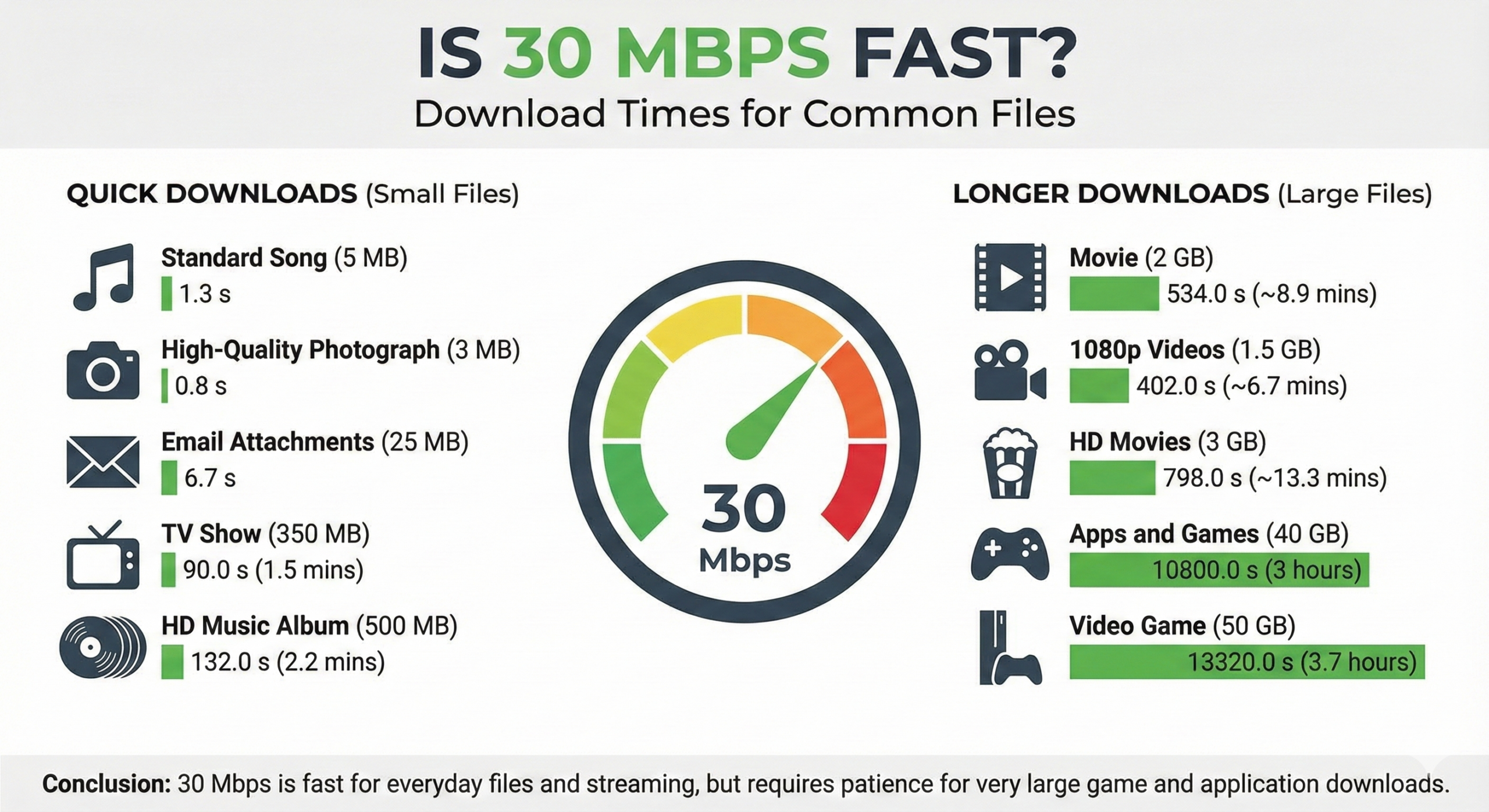
Quick answer: A 30 Mbps connection is usable, but it is not fast by current U.S. standards. It is usually enough for one person or a light two-person household, two or three 1080p streams, one 4K stream on a quiet network, web browsing and an HD video call. It becomes restrictive when several people stream, download games, back up files or join video meetings at the same time.
30 Mbps means up to 30 megabits per second of download bandwidth. That equals a theoretical maximum of 3.75 megabytes per second. Your upload speed, latency, Wi-Fi signal and simultaneous activity also affect how the connection feels.
What can 30 Mbps handle?
| Activity | Does 30 Mbps work? | Realistic expectation |
|---|---|---|
| Browsing, email and social apps | Yes | Several light users |
| 1080p streaming | Yes | About two or three simultaneous streams with headroom |
| 4K streaming | Usually | One stream on a quiet, stable connection |
| Zoom or other video meetings | Yes | One or two HD calls if upload speed is sufficient |
| Online gaming | Yes | Gameplay can be smooth with low latency; downloads are slow |
| Large game or cloud downloads | Limited | A 50 GB download takes at least about 3 hours 42 minutes |
| Busy family home | Often no | Concurrent streaming, calls and downloads can saturate the connection |
These are planning estimates, not guarantees. Streaming services adjust their bitrate, Wi-Fi adds variability and an internet plan advertised as “up to 30 Mbps” may not deliver that rate continuously.
What does 30 Mbps mean?
Mbps means megabits per second. Internet providers normally advertise connection rates in bits, while phones and computers usually show file sizes in bytes. Eight bits equal one byte, so:
- 30 megabits per second ÷ 8 = 3.75 megabytes per second
- 1 GB at the full 30 Mbps rate takes about 4 minutes 27 seconds
- Protocol overhead, Wi-Fi conditions and the remote server normally make real downloads slower
Also check whether “30 Mbps” describes download speed only. Video calls, cloud backups and sending large files depend on upload speed. A plan with 30 Mbps down but a very small upload rate can browse and stream adequately while struggling during outgoing HD video or backups.
Is 30 Mbps fast or slow in 2026?
For a single light user, 30 Mbps can feel responsive. For a modern multi-user household, it is slow. The FCC raised its fixed-broadband benchmark to 100 Mbps download and 20 Mbps upload in March 2024. That benchmark is a policy measure—not a promise that every household needs exactly 100/20—but it provides useful context: 30 Mbps is well below the current U.S. benchmark.
Ranking a speed as “fast” or “slow” without considering the household is misleading. One person watching HD video needs much less capacity than four people streaming, gaming and working remotely at once.
Is 30 Mbps enough for Netflix, YouTube and 4K?
Yes for HD streaming, and usually for one 4K stream. Netflix currently recommends a stable connection of 3 Mbps for 720p, 5 Mbps for 1080p and 15 Mbps for 4K. Google lists approximate sustained rates of 2.5 Mbps for 720p, 5 Mbps for 1080p and 20 Mbps for 4K movies and TV shows on YouTube.
On that basis, 30 Mbps has enough raw bandwidth for multiple HD streams. In practice, leave headroom for phones, smart TVs, software updates and bitrate peaks. Two or three 1080p streams are a more realistic household target than the mathematical maximum.
One Netflix 4K stream can fit within 30 Mbps. One YouTube 4K stream can also fit, but its 20 Mbps recommendation leaves less room for other activity. Two simultaneous 4K streams are not a sensible target on a 30 Mbps plan because they can consume all available bandwidth before overhead or background traffic is considered.
Is 30 Mbps good for working from home and Zoom?
It can be. Office documents, email, messaging and browser-based work use relatively little sustained bandwidth. Video meetings depend more heavily on upload capacity and connection stability.
Zoom lists approximately 2.6 Mbps upload and 1.8 Mbps download for a 720p group call, and 3.8 Mbps upload and 3.0 Mbps download for a 1080p group call. A 30 Mbps download plan easily covers one call, but you still need enough upload bandwidth.
- One remote worker: normally fine for meetings, cloud documents and browsing.
- Two simultaneous HD calls: often fine when the upload rate is comfortably above their combined requirement.
- Calls plus backups or 4K streaming: more likely to stutter because the connection has little spare capacity.
Latency, jitter and packet loss can damage call quality even when a speed test shows 30 Mbps. If meetings matter for work, stability and upload speed deserve as much attention as the headline download number.
Is 30 Mbps fast enough for gaming?
Thirty Mbps is normally enough for active online gameplay. Games usually exchange much less data during play than a video stream. Low latency, low jitter and minimal packet loss matter more than raw download speed.
The drawback is downloading the game itself. Modern titles and updates can be tens or hundreds of gigabytes. At the theoretical full rate, a 50 GB download takes about 3 hours 42 minutes and a 100 GB download takes about 7 hours 24 minutes. Real downloads are usually slower.
Gaming can also lag when another device starts a large download or 4K stream. That is congestion, not proof that the game itself needs a faster connection. Pausing background transfers or using sensible router traffic management can help, but it cannot create more than 30 Mbps of total capacity.
How many devices can 30 Mbps support?
There is no reliable device-count answer. Ten idle smart-home devices may use less bandwidth than one television streaming 4K. Count simultaneous activities, not connected devices.
- Light use: five or more devices can browse, message or play music without continuously using all 30 Mbps.
- Mixed use: three to five active devices can work if only two or three are streaming HD video.
- Heavy use: one 4K television plus a download, cloud backup or HD call can make the connection feel slow.
How long do downloads take at 30 Mbps?
| File size | Best-case time at 30 Mbps | Example |
|---|---|---|
| 100 MB | About 27 seconds | Large document or small app |
| 1 GB | About 4 minutes 27 seconds | Short HD video or app |
| 10 GB | About 44 minutes 27 seconds | Large application |
| 50 GB | About 3 hours 42 minutes | Modern game or large backup |
| 100 GB | About 7 hours 24 minutes | Very large game |
These times use decimal file sizes and assume the entire 30 Mbps is available. Protocol overhead, Wi-Fi interference, server limits and other users increase the real time.
30 Mbps vs. 50, 100 and 300 Mbps
| Download tier | Best fit | Main limitation |
|---|---|---|
| 30 Mbps | One light user or a light two-person household | Concurrent 4K, calls and large downloads |
| 50–60 Mbps | Small household with moderate use | Heavy multi-user activity can still congest it |
| 100 Mbps | Practical starting point for many multi-user homes | Large downloads are faster but not instant |
| 300 Mbps | Busy homes, frequent downloads and several high-bandwidth users | Needs capable Wi-Fi and devices to realize the benefit |
If 30 Mbps is almost enough, see the practical difference in our 60 Mbps speed guide. Do not pay for a faster tier solely because more speed sounds better; match the plan to simultaneous use and the available upload rate.
Check these things before upgrading
- Test with Ethernet. A wired test helps separate an ISP-speed problem from weak or congested Wi-Fi.
- Record download, upload and latency. Run several tests at different times instead of relying on one result.
- Pause background traffic. Cloud sync, console updates, cameras and operating-system downloads can quietly consume the connection.
- Improve router placement. Put it in the open and near the center of the area you use; avoid cabinets and dense obstructions.
- Check the upload tier. A faster download plan with weak upload may not solve video-call or backup problems.
If Ethernet reaches the expected rate but Wi-Fi does not, improve coverage or the local network before buying more internet speed. If you are moving to a faster fiber service and need your own equipment, compare routers for fiber internet by port speed, coverage and features rather than paying for specifications your plan cannot use.
Frequently asked questions
Is 30 Mbps good Wi-Fi speed?
It is adequate for basic use and a small household, but it is not fast by current standards. Remember that 30 Mbps may describe the internet plan, while the Wi-Fi link inside your home can be faster or slower depending on signal and interference.
Is 30 Mbps enough for Netflix?
Yes. Netflix recommends 5 Mbps for 1080p and 15 Mbps for 4K. A 30 Mbps connection can support multiple HD streams or one 4K stream, provided other activity does not consume the remaining bandwidth.
Is 30 Mbps enough for two people?
Usually, if both people browse, stream HD video or make occasional calls. It can feel restrictive if one person streams 4K while the other downloads a large game, backs up files or joins an HD meeting.
Is 30 Mbps good for gaming?
It is normally sufficient for active gameplay when latency and stability are good. Large game downloads and updates are the limitation: a 100 GB download takes at least about 7 hours 24 minutes at 30 Mbps.
Why does 30 Mbps still feel slow?
Common causes include multiple simultaneous users, weak Wi-Fi, a low upload rate, high latency, packet loss, background downloads or an ISP connection delivering less than the advertised rate. Test one wired device with other activity paused to narrow down the cause.
Bottom line
Thirty Mbps is enough for basic internet use, HD streaming, video calls and online gaming in a small household. It is not a fast modern tier, and it offers little headroom for concurrent 4K streaming, large downloads, cloud backups or several heavy users. Check upload speed and wired performance before deciding whether the plan or the Wi-Fi network needs an upgrade.

- Best WiFi 7 Mesh Systems (2026) — Tested & Ranked for Multi-Gig Homes - April 28, 2026
- Best Routers for Verizon FiOS (2026) — WiFi 7 & Mesh Picks Tested - April 13, 2026
- Best 2.5GbE Switches for Home Lab (2026) — Tested & Verified - April 8, 2026