
Netgear router lights are essential indicators that provide valuable information about the status and performance of your WiFi network and router. Understanding what each LED color and pattern means can help you quickly identify and resolve connectivity issues.
In this comprehensive guide, we’ll explore the various Netgear router lights, their meanings, and how to troubleshoot common problems.
NETGEAR documents the meanings itself. On most NETGEAR routers a solid green or white power light means the router is ready, solid amber means it is still powering on, and blinking amber means the firmware is upgrading or Reset was pressed. On the internet light, solid green or white means the connection is ready and solid amber means the router sees the modem but the connection is not ready. Blinking white on the power light means corrupted firmware.
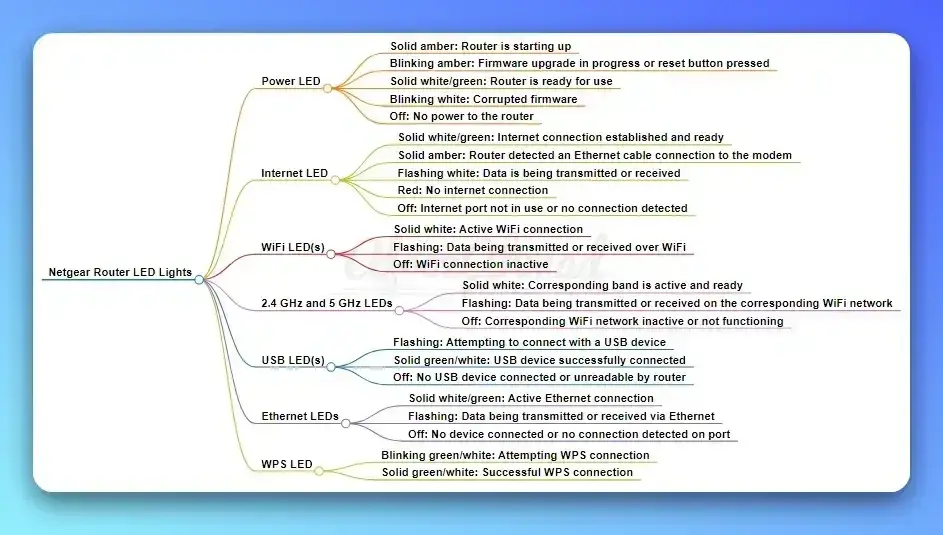
Netgear Router Models and Their LED Lights
- Popular models include Orbi and Nighthawk
- LED lights may vary slightly between models
- Most models have 10-12 LEDs for Internet, Power, LAN, Ethernet, WPS, 2.4 GHz, and 5 GHz
Power LED
NETGEAR documents these states directly. A dark power LED means the router is not powered on. Solid green or white means the router is ready. Solid amber means the router is powering on, and blinking amber means the firmware is upgrading or the Reset button was pressed. Blinking white means the firmware is corrupted — on an R8000, blinking white and amber together means the router is running in access-point mode. If the light is still solid amber, or still blinking, several minutes after a restart, work through NETGEAR’s amber/blinking-power troubleshooting article before assuming the hardware has failed.
-
Solid amber: Router is starting up
-
Blinking amber: Firmware upgrade in progress or reset button pressed
-
Solid white/green: Router is ready for use
-
Blinking white: Corrupted firmware
-
Off: No power to the router
Internet LED
Off means the router cannot see an Ethernet cable between itself and the modem. Solid green or white means the internet connection is ready. Solid amber means the router has detected the modem but the connection is not ready yet, so check the modem’s own lights and reseat the WAN cable. Blinking white means the port is sending or receiving traffic, which is normal.
-
Solid white/green: Internet connection established and ready
-
Solid amber: Router detected an Ethernet cable connection to the modem
-
Flashing white: Data is being transmitted or received
-
Red: No internet connection
-
Off: Internet port not in use or no connection detected
WiFi LED(s)
Off means the WiFi radios are switched off — usually because the WiFi On/Off button on the router was pressed. Solid white means the radios are operating. Blinking means the router is sending or receiving WiFi traffic on that radio.
-
Solid white: Active WiFi connection
-
Flashing: Data being transmitted or received over WiFi
-
Off: WiFi connection inactive
2.4 GHz and 5 GHz LEDs
Dual-band and tri-band NETGEAR routers give each radio its own LED. Off means that radio is switched off, solid white means it is operating, and blinking means the router is sending or receiving traffic on that band. If one band is dark while the other is lit, the radio was disabled in the router’s Wireless settings or by the WiFi button — that is a setting, not a hardware fault.
-
Solid white: Corresponding band is active and ready
-
Flashing: Data being transmitted or received on the corresponding WiFi network
-
Off: Corresponding WiFi network inactive or not functioning
USB LED(s)
Off means no USB device is connected, or the Safely Remove Hardware button was pressed and the drive can now be unplugged. Blinking means a USB device is plugged in and is still connecting. Solid green or white means the device is connected and ready to use.
-
Flashing: Attempting to connect with a USB device
-
Solid green/white: USB device successfully connected
-
Off: No USB device connected or unreadable by router
Ethernet LEDs
Each LAN port has its own LED, and the colour reports the negotiated speed: white or green for Gigabit Ethernet (1 Gbps), amber for 100 Mbps or 10 Mbps. Off means no device is connected to that port, solid means a powered-on device is connected, and blinking means the port is passing traffic. An amber LED sitting next to green ones simply means that link negotiated at 100 Mbps or 10 Mbps rather than Gigabit — often an older cable, connector or network device.
-
Solid white/green: Active Ethernet connection
-
Flashing: Data being transmitted or received via Ethernet
-
Off: No device connected or no connection detected on port
WPS LED
Off means no WPS connection exists, blinking means a WPS pairing is in progress (press the WPS button on the router, then on the client device, within two minutes), and solid means the WPS connection succeeded. There is no need to press the WPS button unless you are deliberately pairing a device.
-
Blinking green/white: Attempting WPS connection
-
Solid green/white: Successful WPS connection
Troubleshooting Common Issues
- Solid amber power light: Amber is normal while the router powers on. If it is still amber several minutes later, restart the router and check the power adapter and connections.
- Solid amber internet light: The router sees an Ethernet connection to the modem but the internet connection is not ready. Power-cycle the modem and router, check the WAN cable, confirm there is no ISP outage, then retest over a wired connection.
- Prolonged flashing blue: Check for physical damage, allow boot-up completion, adjust DHCP settings if needed. Restart router, factory reset if needed.
- Red internet light: Check cables, power off/on, reset if needed, contact ISP.
- Blinking white power light: NETGEAR documents this as corrupted firmware. Recover the router with NETGEAR’s TFTP firmware-recovery procedure, then restart it.
See also:
General Troubleshooting Tips
- Power cycle router and modem
- Check all cable connections
- Confirm if there is an ISP internet outage
- Factory reset as a last resort
When to Contact Netgear Support or Your ISP
Contact Netgear support or your local ISP when:
- Persistent issues after troubleshooting
- Suspected hardware failure
- Ongoing ISP outages or connection problems
Conclusion
Knowing the meaning behind your Netgear router’s LED lights is crucial for diagnosing and resolving network connectivity problems. By referring to this guide, you can quickly interpret the status lights and take appropriate troubleshooting steps. Remember, if issues persist after trying these solutions, don’t hesitate to reach out to Netgear support or your Internet Service Provider for further assistance.
Standards and Primary Sources
Every light meaning on this page is taken from NETGEAR’s own documentation rather than a third-party summary of it. Reviewed and fact-checked on 23 September 2026.
- NETGEAR Support — What do the LEDs on my NETGEAR router mean? (KB 24244) — the official state table behind every section above: power (off / solid green or white = ready / solid amber = powering on / blinking amber = firmware upgrading or Reset pressed / blinking white = corrupted firmware), internet (off = no cable to the modem / solid green or white = ready / solid amber = modem detected but connection not ready / blinking white = traffic), WiFi and WiFi-band LEDs, USB (off / blinking = connecting / solid = ready), Ethernet speed colours (white or green = 1 Gbps, amber = 100 Mbps or 10 Mbps) and WPS (off / blinking = in progress / solid = successful). kb.netgear.com/24244/What-do-the-LEDs-on-my-NETGEAR-router-mean
- NETGEAR Support — What are the LEDs and ports on the front panel of my Nighthawk router called? (KB 23991) — the Nighthawk-specific description: solid amber = the router is starting, blinking amber = firmware upgrading or Reset pressed, solid white = the router is ready, blinking white = corrupted firmware. kb.netgear.com/23991 — Nighthawk front-panel LEDs

- DOCSIS Explained: 3.0 vs 3.1 vs 4.0 and What Sets Your Real Speed - September 29, 2026
- Router Lights Explained: What the Colours Mean on Any Router - September 28, 2026
- eero Light Is White but There Is No Internet: What to Check - September 28, 2026