
Arris modem lights use colour to show connection state rather than raw speed: solid green or blue is online and healthy, blinking means it is still locking on, and amber or red means the modem is not getting a usable signal. Below is the meaning of each light on the SB8200, S33/S34 and SBG10, and what to do about it.
Arris modem lights show whether the device has power, is connected to your cable provider, and—on gateway models—whether Wi‑Fi is active. The SB8200, S33/S34, and SBG10 use different LED layouts, so identify your model first and then match its color or blinking pattern below.
- DOCSIS 3.0
- the cable standard most Arris modems use for their normal green status lights.
- DOCSIS 3.1
- the newer cable standard that Arris shows with a blue Receive or Send light, for higher-speed service.
- Downstream (Receive)
- the signal travelling from your provider to the modem.
- Upstream (Send)
- the signal travelling from the modem back to the provider.
- Locking on
- the moment when the modem scans for and registers channels with the provider. A blinking Receive or Send light means it is still locking on.
- Solid
- a light that stays on without blinking. On these models it reports a finished connection, not live traffic.
Arris Modem Lights: Quick Model Lookup
Identify your Arris model before interpreting its lights. The SB8200 has separate Power, Receive, Send, and Online LEDs; the S33/S34 uses one multi-color status LED; and the SBG10 gateway adds separate 2.4 GHz and 5 GHz Wi-Fi indicators. A blue Receive or Send light means DOCSIS 3.1 service rather than a fault.
| Model | Front-panel lights | Normal online state | What needs attention |
|---|---|---|---|
| SB8200 | Power, Receive, Send, Online | Power and Online are solid green. Receive/Send are green for DOCSIS 3.0 or blue for DOCSIS 3.1. | Receive, Send, or Online keeps flashing after startup. |
| S33/S34 | One multi-color status LED | Solid green means online in DOCSIS 3.0; solid blue means online in DOCSIS 3.1. | Blinking green means channel search; flashing amber means firmware download; alternating blue/green indicates an error state. |
| SBG10 | Power, combined Send/Receive, Online, 2.4 GHz, 5 GHz | The five front LEDs are solid green when their functions are connected; Wi-Fi LEDs may blink during normal traffic. | Send/Receive or Online continues flashing, or the Wi-Fi light stays off when that radio should be enabled. |
Official references: ARRIS SB8200 LED status, ARRIS S33/S34 LED status, and ARRIS SBG10 LED status.
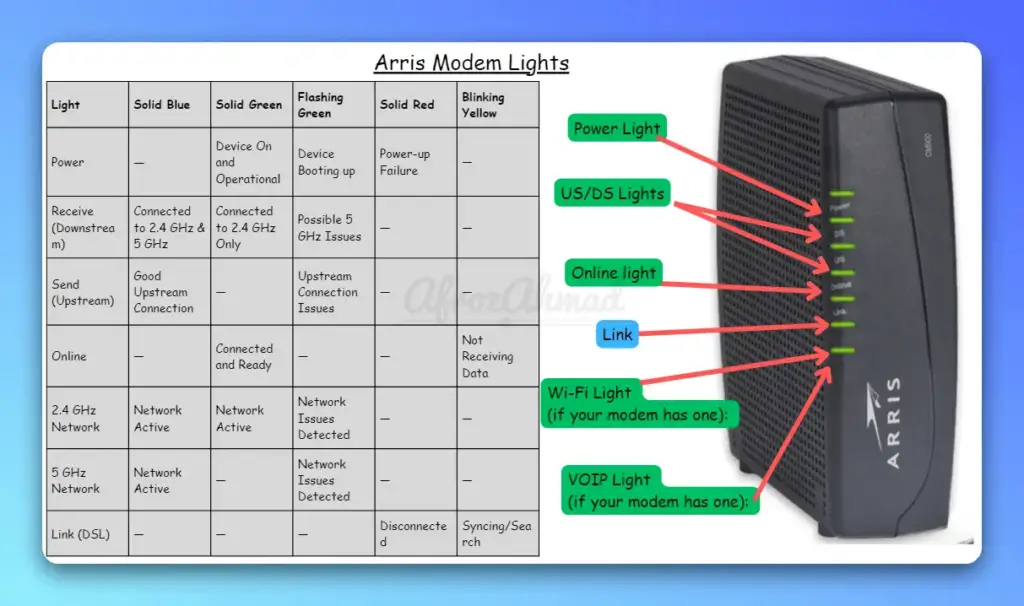
Common Indicator Lights on Arris Modems
Arris SURFboard devices show the same basic connection stages, but their LED layouts and colors differ by model:
- Power/Status – Shows power or overall status. The SB8200 and SBG10 have separate Power LEDs; the S33/S34 uses one multi‑color status LED.
- Downstream (Receive/DS) – Cable signal from your ISP. On the SB8200 Receive LED, flashing means channel search, solid green means DOCSIS 3.0, and solid blue means DOCSIS 3.1. The S33/S34 has no separate Receive LED.
- Upstream (Send/US) – Cable signal to your ISP. On the SB8200 Send LED, flashing means channel search, solid green means DOCSIS 3.0, and solid blue means DOCSIS 3.1. The S33/S34 has no separate Send LED, and the SBG10 combines Send and Receive.
- Online – Shows ISP registration on models with a separate Online LED. Solid green means online on the SB8200 and SBG10; flashing means registration is still in progress.
- Wi‑Fi – (Gateways only, e.g., SBG10) On the SBG10, solid green means a Wi‑Fi connection is present and blinking green means wireless activity.
- Telephone/Voice – (Telephony models only) Landline service status.
Some models also include additional indicators:
- Link – Ethernet link/activity on the rear LAN port(s): green often = 1 Gbps, amber = 10/100; blinking = traffic.
- Broadband/WAN – Used on certain gateways; not present on modem‑only units.
- 2.4 GHz / 5 GHz – (Gateways) Band‑specific radio indicators: solid = band enabled; blinking = client activity.
- Ethernet – Wired port status (link speed/activity) on gateways.
Understanding these functions is the first step. See also: Technicolor Modem Lights
Meaning of Key Indicator Lights
Use the model lookup above first, then use the sections below to interpret each light and troubleshoot the affected connection stage.
Now, let’s explore specific indicators and model‑aware nuances:
Power Light
This light shows power or, on the S33/S34, overall modem status. The pattern depends on the model:
- SB8200 – The Power LED does not flash; solid green means power is connected. Internet registration is shown by the separate Online LED.
- S33/S34 single status LED – Flashing amber means a firmware download; blinking green means channel search; solid green means online in DOCSIS 3.0; solid blue means online in DOCSIS 3.1; alternating blue and green indicates an error mode.
- SBG10 – The Power LED does not blink; solid green means power is connected.
If the SB8200 or SBG10 Power LED stays off after you check the approved adapter and outlet, contact your ISP or ARRIS support. On the S33/S34, use the single status-LED patterns above before assuming a power fault.
Downstream Light
Also labeled “Receive” or “DS”—this is your modem’s connection from the ISP.
- Flashing (color varies) – Scanning for downstream channels; not yet locked.
- Solid Green – Channels locked (typically DOCSIS 3.0).
- Solid Blue – On the SB8200 Receive LED, blue means the downstream connection is using DOCSIS 3.1. The S33/S34 does not have a separate downstream LED.
On the SB8200, a green Receive LED means the downstream connection is using DOCSIS 3.0; blue means DOCSIS 3.1. Either can provide service, depending on ISP provisioning.
Upstream Light
Also labeled “Send” or “US”—this is your modem’s connection to the ISP.
- Flashing (color varies) – Scanning for upstream channels; not yet locked.
- Solid Green – Upstream locked (DOCSIS 3.0).
- Solid Blue – On the SB8200 Send LED, blue means the upstream connection is using DOCSIS 3.1; green means DOCSIS 3.0. The S33/S34 has no separate upstream LED, and the SBG10 uses one combined Send/Receive LED.
If this light won’t go solid after a power cycle, check cabling and contact your ISP to verify upstream power levels and provisioning.
Online Light
This indicates internet registration status.
- Solid Green – On the SB8200 and SBG10, solid green means the modem is online.
- S33/S34 status LED – These models have no separate Online LED. Their single status LED is solid green for DOCSIS 3.0 or solid blue for DOCSIS 3.1.
- Flashing Online LED – On the SB8200 or SBG10, registration is still in progress. Persistent flashing can indicate a signal or ISP provisioning issue.
If problems persist, you won’t have internet access until the modem completes registration—verify signal and account provisioning with your ISP.
Wi‑Fi Lights
On the SBG10 gateway, the 2.4 GHz and 5 GHz LEDs show Wi‑Fi connection and activity.
- Solid – Radio enabled.
- Blinking – Normal wireless traffic/activity (not necessarily an issue).
- Off – Radio disabled.
If devices can’t connect over Wi‑Fi but the online LED is solid, focus on Wi‑Fi settings and client device configuration.
Troubleshoot an Arris Modem by Its Lights
Amber, red, or a light that never stops blinking: check the coax connector at the wall and at the modem, remove any unnecessary splitter, then power-cycle the modem and give it a few minutes to lock. If Receive or Send still will not go solid, ask your provider whether there is an outage or a signal fault on your line — that problem sits upstream of your equipment.
Use the LED states to troubleshoot methodically. Note that cable‑modem firmware and channel bonding are controlled by your ISP; you cannot manually force firmware updates or “reset channels.”
Here is a step-by-step troubleshooting guide to resolve common Arris modem issues based on the indicator light status:
Power or Status Light Is Off
If your modem has no lights at all, the first step is checking the power supply. Try the following:
- Reconnect the power adaptor firmly into the wall socket and modem power port.
- Use a different wall socket or bypass the power strip.
- Test the socket with another appliance to verify it’s working.
- If the modem still doesn’t power on, the adaptor/modem hardware may be defective—contact your ISP or the manufacturer.
Downstream Light Keeps Blinking
A flashing downstream light means the modem is scanning; a solid green/blue indicates a lock. To improve signal quality:
- Ensure the coaxial cable is finger‑tight at both the wall and the modem.
- Connect the modem directly to the wall jack (avoid splitters if possible).
- Reboot the modem; then check the Status/Signal page for downstream power and SNR. If levels are out of spec, contact your ISP.
- If the light never stabilizes, request a technician to inspect outside lines and connectors.
Upstream Light Blinking Continuously
A constantly flashing upstream light indicates the modem can’t lock upstream channels:
- Check coax fittings and remove unnecessary splitters or attenuators.
- Power cycle the modem and review upstream power levels on the Status page.
- If levels are too high/low or provisioning failed, contact your ISP; firmware/channel profiles are ISP‑managed.
- Persistent failure after line fixes may indicate hardware replacement is needed.
Online Light Keeps Blinking
On the SB8200 or SBG10, a blinking Online LED means the modem is still registering with the cable network. On the S33/S34, solid green or blue means online; alternating blue and green indicates an error mode. If registration does not finish, try the following:
- Power cycle the modem and connected devices (router, computer, etc.).
- Confirm your devices receive valid IP addresses once the modem shows solid online.
- Log into the modem’s admin interface to view WAN status; if provisioning failed, contact your ISP to activate the modem.
- Ask your ISP to verify signal levels and account configuration.
No Wi‑Fi Connection on the SBG10
If you’re using a gateway (SBG series) and can’t connect wirelessly, first check that the 2.4 GHz/5 GHz lights are solid (radios on). If radios are off or there’s no traffic:
- Reboot the gateway to re‑enable radios and clear temporary faults.
- Verify Wi‑Fi settings like SSID and password (match the device label if unchanged).
- Update client device Wi‑Fi drivers and test multiple devices to isolate client issues.
- Use a factory reset only after other troubleshooting fails. It erases the SBG10’s custom settings, so you must reconfigure Wi‑Fi afterward.
For persistent Wi‑Fi issues with a solid online LED, your ISP can confirm signal to the gateway; hardware replacement may be appropriate if radios fail.
Helpful Troubleshooting Tips
Record the pattern before you reboot. Note the colour, which LED it is, and whether it is solid or blinking. That tells you which stage failed, and you lose the evidence the moment the modem restarts.
Beyond LED checks, apply these basics:
- Inspect all cable connections: Loose coaxial, Ethernet, or power cables can cause intermittent connectivity. Verify fittings are snug.
- Eliminate signal splitters if possible: Multiple devices on the same splitter can degrade signal quality. Connect the modem directly to the outlet if feasible.
- Power cycle equipment: Power off and back on the modem, router, and connected devices for a fresh signal lock.
- Check for ISP network outages: Confirm with your provider if there are service alerts for your area before deep troubleshooting.
- Firmware handling: Cable‑modem firmware is controlled and pushed by your ISP; users cannot manually update.
- Factory reset as a last resort: This erases custom settings. On the SBG10, back up the configuration first when possible and be prepared to reconfigure Wi‑Fi.
- Request replacement hardware: If all else fails, older or faulty units may need replacement.
Interpreting LEDs alongside signal levels in the admin interface is the fastest way to separate in‑home issues from ISP signal or provisioning problems.
Prevent Repeat Connection Problems
Good cabling and placement prevent many stability issues. Follow these tips:
✔️ Use the manufacturer‑approved power adapter to avoid electrical damage.
✔️ Position the modem/gateway away from large electrical appliances and thick obstructions.
✔️ Allow ISP‑pushed firmware updates to complete uninterrupted.
✔️ Check indicator lights periodically to spot early warnings.
✔️ Contact ISP support for recurring errors, especially when LEDs won’t lock or the online light keeps blinking.
A correctly functioning modem ensures reliable internet for work and entertainment. Use the LEDs as your quick diagnostic dashboard, and loop in your ISP when signal or provisioning needs attention.
Conclusion: Monitor Lights for Fast Diagnosis
Read the pattern for your exact model: separate LEDs on the SB8200, one status LED on the S33/S34, and five front LEDs on the SBG10. This tells you whether the device has power, is still searching for cable channels, is registered online, or needs ISP support.
If your upstream never locks, the online light stays blinking, or the S33/S34 status LED alternates blue and green, collect screenshots of the Status/Signal page and contact your ISP for signal and provisioning checks.
FAQ
What do the lights on my Arris modem indicate?
Answer: Depending on the model, the LEDs show power or overall status, cable-channel search and lock, ISP registration, Wi‑Fi activity, and Ethernet link speed. Use the model lookup above before interpreting a color.
What should I do if my Arris modem’s power or status light is off?
Answer: For an SB8200 or SBG10, verify the approved power adapter, wall outlet, and cable connection. On an S33/S34, an unlit status LED means no power. If it remains off, contact your ISP or ARRIS support.
What does a flashing green light on the Arris modem’s receive or send light signify?
Answer: It is scanning for cable channels, not showing a Wi‑Fi band. On the SB8200, solid green means DOCSIS 3.0 and solid blue means DOCSIS 3.1. On the SBG10, the combined Send/Receive LED is solid green when its channels are connected. The S33/S34 has no separate Receive or Send LED.
My Arris modem’s online light is blinking. What does this mean?
Answer: On the SB8200 or SBG10, blinking means registration is in progress. If it never turns solid green, reboot once and contact your ISP to verify signal and activation. The S33/S34 has no separate Online LED; use its single status light instead.
Can the color of the lights on my Arris modem indicate a problem?
Answer: Yes, but the meaning depends on the model. On the SB8200 Receive and Send LEDs, green means DOCSIS 3.0 and blue means DOCSIS 3.1. On the S33/S34 single status LED, green means online in DOCSIS 3.0 and blue means online in DOCSIS 3.1. The SBG10 uses green for its normal front-panel states.
What steps can I take to troubleshoot a Wi‑Fi connectivity issue on my Arris modem?
Answer: On the SBG10, solid 2.4/5 GHz LEDs mean a Wi‑Fi connection is present, while blinking means traffic. Reboot and verify the SSID and password first. Use a factory reset only as a last resort because it erases custom settings.
How do I check whether my Arris modem’s firmware is up to date?
Answer: Cable‑modem firmware is ISP‑managed and delivered automatically. You can view the current version in the admin interface; contact your ISP for update status.
Can I fix my Arris modem’s connectivity issues without calling tech support?
Answer: Often yes: reseat coax and power, remove splitters, reboot, and check the Status/Signal page. Call your ISP if levels are out of spec or provisioning fails.
What do amber or alternating lights mean on the S33/S34?
Answer: On the S33/S34, flashing amber means a firmware download is in progress. Alternating blue and green indicates an error mode. Allow the firmware download to finish; if the alternating error pattern persists, check the cables and contact your ISP or ARRIS support.
Why are the receive and send lights on my modem different colors?
Answer: On the SB8200, the Receive and Send LEDs can use different colors because downstream and upstream can be operating in different DOCSIS modes. Green means DOCSIS 3.0 and blue means DOCSIS 3.1. The S33/S34 and SBG10 do not have separate Receive and Send LEDs.
Sources and Primary Sources
Every light meaning on this page comes from Arris’s own model documentation. All three articles were opened and re-checked on 30 September 2026.
Blue*: High-speed Internet connection with downstream channels in DOCSIS 3.1 mode.Arris, “SB8200: LED Light Status” (Article 000023895, Validation Status: Validated)
- Arris, SB8200: LED Light Status.
- Arris, S33/S34: LED Light Status.
- Arris, SBG10: LED Lights Status.
Reviewed and fact-checked on 30 September 2026 against the three Arris articles listed above. Light meanings differ between models, so confirm your model number before acting on a colour.
Afroz Ahmad, “Arris Modem Lights (SB8200, S33, SBG10): Meanings, Problems & Fixes”, afrozahmad.com, reviewed 30 September 2026.
https://afrozahmad.com/blog/arris-modem-lights/
About this page. Researched and written by Afroz Ahmad, a CCIE with more than 20 years designing enterprise, ISP and carrier networks. Each light meaning is quoted from Arris’s own documentation and was re-checked on 30 September 2026.

- DOCSIS Explained: 3.0 vs 3.1 vs 4.0 and What Sets Your Real Speed - September 29, 2026
- Router Lights Explained: What the Colours Mean on Any Router - September 28, 2026
- eero Light Is White but There Is No Internet: What to Check - September 28, 2026