
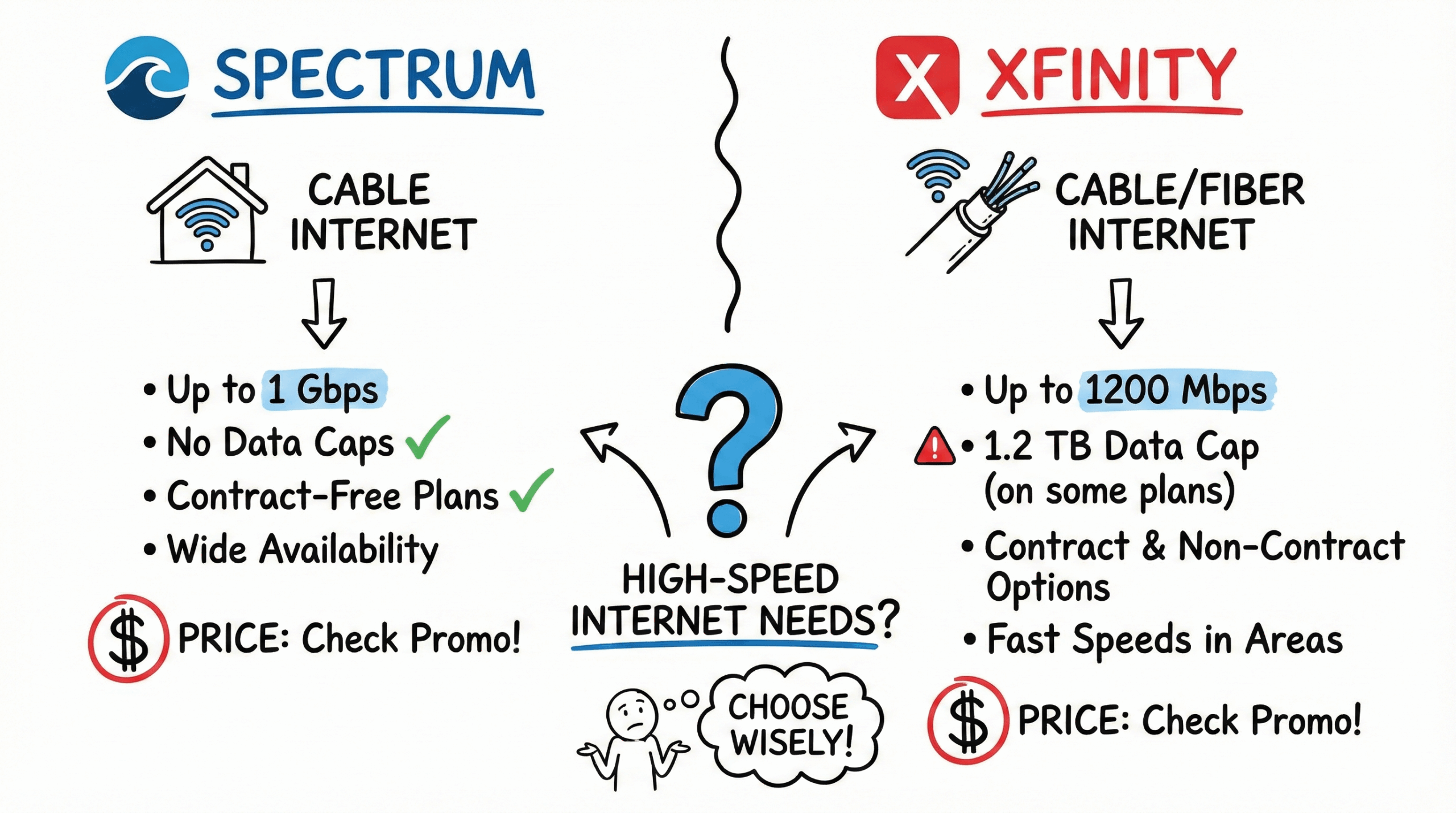
Choosing between Spectrum vs Xfinity for your high-speed internet needs? This guide dives into crucial aspects like speed, data caps, cost, performance, and customer service to help you determine the best fit for your household in 2025. Stay tuned for an in-depth comparison.
Key Takeaways
- Spectrum offers unlimited data on all plans, a major advantage for heavy users.
- Xfinity generally provides faster maximum speeds, including widely available cable gigabit plans and multi-gig fiber in select areas.
- Spectrum has simpler pricing and requires no contracts, while Xfinity offers more plan variety and bundling flexibility, often with contract requirements.
- Both providers offer discounted promotional pricing for new customers, typically for the first 12 months.
- Spectrum is recommended for straightforward, worry-free internet, while Xfinity suits users who want the fastest speeds or plan to bundle TV, mobile, and home security.
Here is a detailed comparison table of Spectrum vs Xfinity:
| Feature | Spectrum | Xfinity |
|---|---|---|
| Coverage | 41 states | 40 states |
| Internet Plans | 300 Mbps, 500 Mbps, and 1 Gbps | 75 Mbps – 6 Gbps |
| Data Caps | No data caps | 1.2 TB data cap (unlimited on Gigabit+ plans) |
| Contracts | No contracts | Optional 1 or 2 year contracts for best pricing |
| Starting Price Range | $49.99 – $89.99/mo | $20 – $300/mo |
| Price After Promo Period | +$30/mo or more | Varies, up to +$30/mo or more |
| Gigabit Availability | Widespread (Cable) | Widespread (Cable); Limited (Fiber) |
| Installation Fee | $65 pro install $24.99 self-install | $100 pro install Free self-install kit |
| Equipment Fee | Modem free Router $7/mo | Gateway $14/mo or more |
| Early Termination Fee | None | Up to $240 |
| Customer Service | 24/7 phone, chat, and support site | 24/7 phone, chat, support site |
| ACSI Rating (2024) | 66/100 | 70/100 |
| Bundles Available | Internet + TV + Voice + Mobile | Internet + TV + Voice + Home Security + Mobile |
| Streaming Perks | Occasional limited-time promotions for services like Max | Discounted Peacock Premium subscription |
An Introduction to Spectrum and Xfinity
Spectrum and Xfinity are two of the largest cable internet providers in the United States.
Spectrum is the consumer brand for Charter Communications, which offers cable TV, phone, and internet service under the Spectrum name. After acquiring Time Warner Cable and Bright House Networks in 2016, Spectrum expanded its service area to be available in 41 states, making it the second largest cable internet provider in the country.
Xfinity is the internet service brand for Comcast, the nation’s largest cable company. Xfinity Internet is available in 40 states and also provides cable TV and phone service bundled under the Xfinity name. Xfinity has over 32 million high-speed Internet customers nationwide.
Both companies continue to grow their fiber-optic networks, which allow for faster gigabit internet speeds. However, the majority of connections from Spectrum and Xfinity still come via cable internet delivered over coaxial cables.
When it comes to reputation, customer satisfaction scores for both providers are typically near the industry average. According to the American Customer Satisfaction Index (ACSI) 2024 report, Xfinity scored a 70 out of 100, while Spectrum scored a 66. Still, being among the few options available in many areas makes them leading choices for high-speed internet access.
Availability and Coverage Map
The first thing to check when comparing Spectrum vs Xfinity is whether either provider services your area. There is considerable overlap in major metropolitan areas, but one may be available where the other is not.
Spectrum has a presence in 41 states, with major service areas in California, Texas, New York, Florida, and the Carolinas.
Xfinity covers 40 states, with a large footprint in California, Florida, Illinois, Pennsylvania, and the Northeast.
To confirm availability at your address, you must check the coverage maps and enter your ZIP code on the Spectrum and Xfinity websites. Depending on where you live, you may find that only one provider services your neighborhood.
Internet Plans and Speeds
When it comes to internet tiers and speeds, Spectrum takes a simplified approach while Xfinity offers a wider variety of options.
Spectrum Internet Plans
Spectrum Internet is available in three main speed tiers:
- Spectrum Internet® with speeds up to 300 Mbps
- Spectrum Internet Ultra with speeds up to 500 Mbps
- Spectrum Internet Gig with speeds up to 1 Gbps (940 Mbps)
The advertised speeds represent the maximum wired connections can reach. Actual speeds will vary based on network conditions, your equipment, and other factors.
All Spectrum residential plans are contract-free with no data caps and include a free internet modem. You can add TV and phone services to create a bundle.
Spectrum Pricing
Spectrum runs frequent promotions for new customers, offering discounted pricing for the first year of service. Regular rates take effect after the 12-month introductory period.
Here are the typical starting prices and regular rates for Spectrum Internet plans:
| Spectrum Plan | New Customer Promo Price | Regular Monthly Price |
|---|---|---|
| Spectrum Internet (300 Mbps) | $49.99/mo for 12 mos | $79.99/mo |
| Spectrum Internet Ultra (500 Mbps) | $69.99/mo for 12 mos | $99.99/mo |
| Spectrum Internet Gig (1 Gbps) | $89.99/mo for 12 mos | $119.99/mo |
Xfinity Internet Plans and Pricing
Xfinity segments its internet service areas into three regions—Central, West, and Northeast—with around 5-7 different speed tiers available in each. This allows Xfinity to tailor plans and pricing to local markets, but it can also make finding a clear price more complex.
In general, Xfinity internet speeds range from 75 Mbps up to 6 Gbps, with a mix of cable and fiber-optic connections. Most plans use their cable network, while multi-gigabit fiber speeds are only available in very limited areas.
Xfinity plans can be month-to-month, but signing a 1 or 2-year contract typically unlocks the best promotional rates.
Here are sample plans and pricing from the Central region to give an idea of what Xfinity offers:
| Package | Price Range | Download Speeds | Upload Speeds | Best For |
|---|---|---|---|---|
| Connect | $19.99–$25.00/mo. | 75 Mbps | 10 Mbps | 1-2 people, basic browsing, email, and SD streaming on a few devices. |
| Connect More | $30.00–$35.00/mo. | 200 Mbps | 10 Mbps | Small families, HD streaming, online gaming, and connecting up to 8 devices. |
| Fast | $50.00–$60.00/mo. | 400 Mbps | 10 Mbps | Larger households, 4K streaming, multiple simultaneous video calls. |
| Superfast | $60.00–$70.00/mo. | 800 Mbps | 20 Mbps | Power users, serious gamers, and homes with many connected smart devices. |
| Gigabit | $65.00–$80.00/mo. | 1,000 Mbps (1 Gbps) | 20 Mbps | Large file downloads, running a home server, and future-proofing your network. |
| Gigabit Extra | $70.00–$85.00/mo. | 1,200 Mbps (1.2 Gbps) | 35 Mbps | Maximum cable performance for the most demanding households. |
Comparing Download Speeds
When comparing Spectrum vs Xfinity download speeds, Xfinity has a slight edge with its widely available 1.2 Gbps cable plan and its ultra-fast (but rare) multi-gig fiber plans. Spectrum’s top speed for most customers is 1 Gbps via its cable network.
Both companies use technologies like DOCSIS 3.1 to optimize performance over their cable infrastructure. For the vast majority of households, the speeds offered by both Spectrum and Xfinity are more than sufficient for streaming, gaming, video conferencing, and running dozens of devices at once.
Upload Speeds: A Critical Factor for Modern Users
While download speeds get most of the attention, upload speeds have become increasingly important for video conferencing, live streaming, online gaming, and uploading large files to the cloud. This is one area where a significant difference can emerge between Spectrum and Xfinity.
Spectrum’s cable plans typically offer upload speeds between 10 Mbps and 35 Mbps. While functional for most tasks, this can be a bottleneck for content creators or households with multiple people on Zoom calls simultaneously.
Xfinity is actively upgrading its network with “mid-split” technology, which dramatically increases upload speeds on its cable plans. In upgraded areas, Xfinity customers can get upload speeds of 100 Mbps or even 200 Mbps on plans like Superfast and Gigabit Extra. This gives Xfinity a clear advantage for users who need robust upload performance. However, these upgrades are not yet available everywhere, so you’ll need to check what’s offered at your specific address.
Performance and Reliability
With cable internet, reliability often comes down to the quality of the local infrastructure. Both Spectrum and Xfinity have invested heavily in upgrading their networks with a hybrid of fiber-optic and coaxial cables.
Network congestion can still occur during peak evening hours, potentially leading to slower-than-advertised speeds. However, recent data shows both providers are delivering on their promises.
According to the FCC’s 2023 Measuring Broadband America report, both Spectrum and Xfinity delivered over 100% of their advertised median download speeds during peak hours:
- Spectrum (Charter) delivered 114.7% of advertised download speeds.
- Xfinity (Comcast) delivered 120.7% of advertised download speeds.
This data suggests that, on average, customers of both ISPs are receiving the speeds they pay for, even during the busiest times. Both providers also use network management techniques to prioritize time-sensitive traffic like streaming and gaming to ensure a smooth experience.
Installation and Equipment
Spectrum and Xfinity both offer professional installation or a self-install kit to get your service up and running.
Spectrum Equipment and Installation
Spectrum provides a compatible modem at no extra charge with your service. Using their WiFi router costs an additional monthly fee, or you can use your own compatible router to avoid the charge.
- Professional installation – Starts at $65
- Self-installation – $24.99 activation fee
Xfinity Equipment and Installation
Xfinity provides an xFi Gateway device that combines a modem and router. Renting this equipment comes with a monthly fee. You also have the option to use your own Xfinity compatible router and modem to save money.
- Professional installation – $100
- Self-installation – Free (just pick up a Getting Started kit)
If you’re comfortable with tech, Xfinity’s free self-install kit is the most cost-effective option. If you prefer a professional setup, Spectrum’s fee is lower.
Data Caps
Data caps are a crucial differentiating factor. Spectrum takes a clear lead here by offering truly unlimited data with no caps on any of its residential internet plans. You can download, stream, game, and browse as much as you want without worrying about overage fees.
Xfinity, on the other hand, enforces a 1.2 TB data cap on most of its plans below the Gigabit tier.
- 1.2 TB data cap on most plans.
- No data cap on Gigabit, Gigabit Extra, and faster fiber plans.
While 1.2 TB is a generous amount of data for the average household, heavy users—especially those streaming 4K video, downloading large games, and running multiple devices—can exceed it. Xfinity charges $10 for each additional 50 GB of data used, up to a maximum of $100 per month. Alternatively, you can add an unlimited data option for about $30 per month.
If your household uses a lot of data or you simply don’t want to monitor your usage, Spectrum’s no-data-cap policy is a significant advantage.
Promotions and Deals
Both Spectrum and Xfinity run frequent promotions to attract new subscribers. Here are some common deals to look for:
Spectrum New Customer Promotions
- Discounted introductory pricing for 12 months on internet plans.
- Up to $500 contract buyout to cover early termination fees from your old provider.
- Visa gift card rewards for signing up for select bundles.
Xfinity New Customer Promotions
- Discounted pricing for 12-24 months, especially with a term agreement.
- Prepaid gift cards (up to $300) for signing up for higher-speed plans.
- Bundle deals that include discounts on Xfinity Mobile.
- Discounted subscription to the Peacock Premium streaming service.
Always ask about current promotions when you sign up. Just remember that the price will increase significantly after the introductory period ends, so be sure to budget for the regular rate.
Bundle Options
Bundling TV, internet, and phone services can offer convenience and savings. Both providers heavily promote their bundles.
Spectrum Bundles
Spectrum offers straightforward bundles, often called “Double Play” (Internet + TV or Phone) and “Triple Play” (Internet + TV + Phone). A key benefit is that Spectrum bundles, like its internet-only plans, do not require a contract.
Xfinity Bundles
Xfinity offers a wider and more customizable range of bundles. You can mix and match internet, TV, voice, and even home security services. To get the best prices on Xfinity bundles, you’ll typically need to agree to a one or two-year contract.
Spectrum Mobile vs. Xfinity Mobile: Bundle and Save
One of the biggest bundling perks offered by both providers is access to their mobile services, Spectrum Mobile and Xfinity Mobile. Both are Mobile Virtual Network Operators (MVNOs) that run on Verizon’s powerful and reliable 4G LTE and 5G network.
To be eligible, you must be an internet customer of the respective provider. Both offer competitive pricing with “By the Gig” and “Unlimited” data plans that can result in significant savings compared to major carriers. If you’re looking to consolidate your bills and lower your mobile costs, bundling your internet and mobile service with either Spectrum or Xfinity is a compelling option.
Availability of Gigabit Internet
Gigabit-speed internet is now widely available from both providers, but it’s important to understand the technology behind it.
Spectrum’s 1 Gbps plan is delivered over its existing cable network and is available almost everywhere Spectrum offers service. This makes gigabit speeds highly accessible to its customers.
Xfinity also offers widespread gigabit speeds over its cable network, with plans like ‘Gigabit’ (1 Gbps) and ‘Gigabit Extra’ (1.2 Gbps) available to most of its customers. Where Xfinity truly stands apart is with its fiber-to-the-home service, ‘Gigabit Pro’. This plan offers incredible symmetrical speeds up to 6 Gbps. However, it’s crucial to note that Gigabit Pro is extremely limited in availability, requires a professional site survey, and is significantly more expensive (around $300/mo) than standard cable gigabit plans.
For most users seeking gigabit speeds, both providers offer excellent options over cable. If you happen to live in one of the few areas with access to Xfinity’s Gigabit Pro and have the budget and need for multi-gig speeds, Xfinity is the unparalleled choice.
Customer Service
Both providers offer multiple channels for customer support, including 24/7 phone and chat options, extensive online help portals, and social media assistance.
Historically, cable companies have not been known for stellar customer service. However, recent satisfaction scores show some improvement. In the 2024 ACSI Telecommunications Report, Xfinity (70/100) edged out Spectrum (66/100). That said, your personal experience can vary greatly depending on the local technicians and support representatives in your area.
For those new to Xfinity, our guide on how to activate your Xfinity modem can streamline the setup process.
Additional Perks and Features
A few extra features help differentiate Spectrum and Xfinity:
Spectrum- Free access to a nationwide network of WiFi hotspots.
- Free antivirus software (Security Suite) for internet customers.
- No-contract policy on all services, providing maximum flexibility.
- Access to millions of WiFi hotspots nationwide.
- The xFi Gateway includes advanced security features and parental controls.
- Access to the Xfinity Flex 4K streaming box and a discounted Peacock Premium subscription for internet-only customers.
If you frequently use public WiFi, both companies allow you to connect to hotspots at no extra cost when you’re an internet customer.
You can also read our comparison on Google Fiber vs Xfinity: Which is The Better Choice?
Final Verdict: Which is Better, Spectrum or Xfinity?
So, who wins the Spectrum vs. Xfinity showdown? The best provider truly depends on your individual priorities.
Reasons to choose Spectrum:- You want the freedom of unlimited data without monitoring usage.
- You prefer simple, straightforward plans and pricing.
- You want to avoid contracts and early termination fees.
- You want access to the fastest available speeds, including multi-gig fiber where available.
- You need faster upload speeds for work, streaming, or content creation.
- You plan to bundle multiple services like mobile, TV, and home security for the best value.
- Your data usage is consistently below the 1.2 TB monthly cap.
For the majority of households, Spectrum is our top recommendation.
Spectrum’s combination of no data caps, no contracts, and simple, transparent pricing gives it a powerful edge for everyday internet users. It removes the biggest pain points of internet service: worrying about overage fees and being locked into a long-term agreement. The speeds are more than fast enough for almost any household.
However, Xfinity is the clear winner for power users and bundlers. If you demand the absolute fastest download and upload speeds, or if you want to consolidate your internet, mobile, and home security onto a single bill, Xfinity’s extensive options and aggressive bundle pricing are hard to beat—as long as you’re comfortable with a contract and a data cap.
Ultimately, your first step should always be to check availability at your address. If both are an option, weigh what matters most to you: the simplicity and freedom of Spectrum or the raw speed and bundling power of Xfinity.
Frequently Asked Questions
Is Spectrum cheaper than Xfinity?
Xfinity often has cheaper introductory promotional prices, especially for its lower-speed tiers. However, Spectrum can be cheaper in the long run for heavy data users because all its plans include unlimited data, whereas adding unlimited data to an Xfinity plan costs extra (around $30/mo).
Which is better for gaming, Spectrum or Xfinity?
For most gamers, both providers offer low latency and fast download speeds suitable for a great gaming experience. However, Xfinity gets the edge in areas where it has rolled out its ‘mid-split’ network upgrades, which provide much faster upload speeds. Faster uploads can improve the experience in multiplayer games and are essential for streaming your gameplay on platforms like Twitch.
Does Spectrum have contracts?
No, Spectrum does not require contracts for any of its residential services, including internet, TV, and phone. This is a major advantage, as it allows you to change or cancel your service at any time without facing an early termination fee (ETF).

- pfSense 10G Home Lab Setup: Complete Hardware Guide (2026) - April 1, 2026
- Best Budget Home Lab Setup Under $300 (2026): Complete Starter Stack - March 30, 2026
- Best Modems for Spectrum: Top DOCSIS 3.1 Picks That Actually Work - March 28, 2026